




For most people, Tax Day meant stress about last year. But, for one of Franklin’s top heritage tourism attractions, April 15 was all about its future.
That day, Jim Akins, the long-time leader of the world’s only museum dedicated to Scottish tartans and heritage, announced that Cara Pace, 28, was the new steward of the museum’s collection.
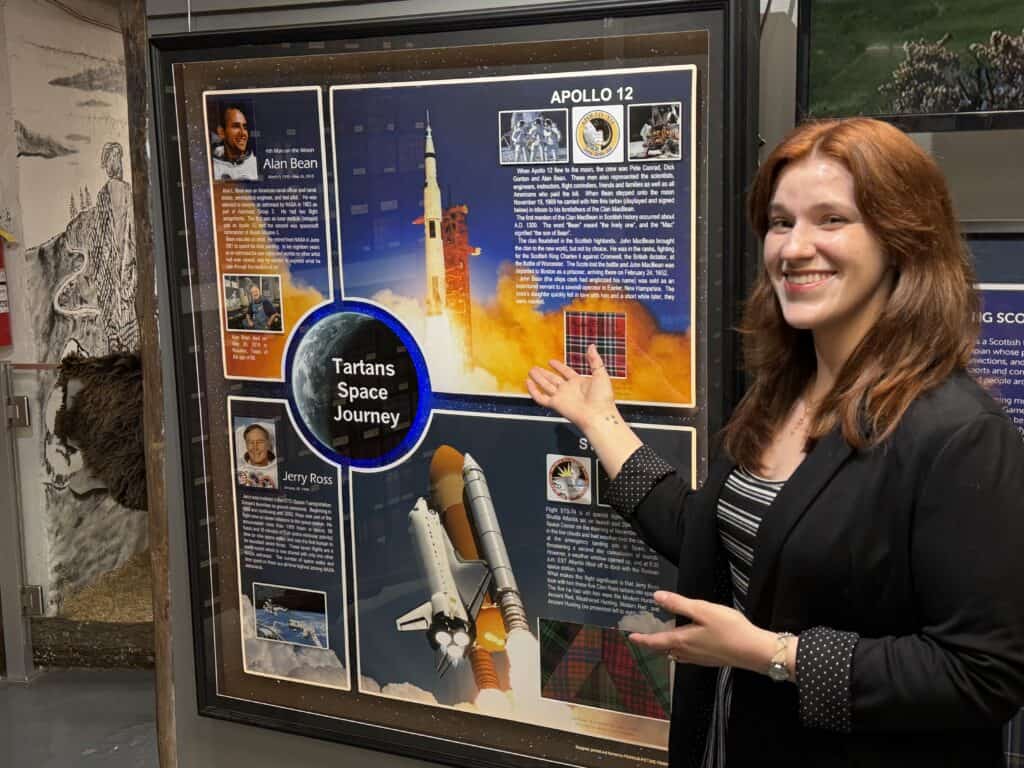
Fans of the organization would certainly notice the change as its Facebook page suddenly came alive that day with posts discussing Scots on the Titanic and the Battle of Culloden.
Anyone who’s gotten to know Pace – personally or through her digital content – knows the anthropology graduate from Appalachian State is passionate about the past. And that’s a big positive for Scots around Macon County and beyond.

Like so many in Franklin these days, Pace grew up elsewhere – Fairhope, Alabama – and luckily for Macon County, her family had a second home here. She spent much of her childhood roaming these mountains. And once she became an App State Mountaineer, the die was cast. She became a full-time WNC resident.
An impactful introduction
Prior to her new job, one could argue Pace introduced herself in two ways.
The first is “History with Cara”, a digital passion project that garnered more than 80,000 followers combined on YouTube, Tic Tok, Facebook, Instagram and Lemon8. To cynics, that might seem like a “small” number for an influencer, but in reality, her self-proclaimed “history girlie” videos reached millions of views. One video, set at the Titanic Museum, earned nearly nine million views alone.
The second was when she recorded a visit to Franklin’s Scottish Tartan Museum and Heritage Center. That’s where she got the attention of Akins and his board. And, as of April 15, the rest is history. Or is it, the rest is the future?
Macon Sense got the chance to meet up with Cara (pronounced care-ah) to talk about her journey to Franklin and her vision for the museum’s future. We discussed which of her history videos were most popular and which one earned a shocking audience reaction.
During the conversation, Pace easily contextualized how history and anthropology led to her love of Franklin and Scotland. And, why her desire to teach helps position the museum to welcome a new era of reaching more people in modern ways.
Macon Sense: Where are you from and how did you get to Franklin?
Cara Pace: I am from the Gulf Coast of Alabama, a little town called Fairhope, south of Mobile.
My family always had a vacation cabin in Franklin, and my brother went to the University of Tennessee. So, I spent a lot of my childhood in the mountains one way or the other. I ended up graduating from high school early and I got an offer from Appalachian State. A few years ago, my parents ended up moving to Franklin full time, and a couple years ago, I bought a home here and ended up here as well.
Macon Sense: Do you miss the Gulf Coast and the beach?
Pace: In some ways I do, but I love the way the mountains hug you. I like the landscape. I think it fits who I am a lot more.
Macon Sense: Besides “the hug”, what else do you love about these mountains?
Pace: I’ve been lucky enough to spend quite a lot of time in Scotland and it always strikes me how similar the landscape is from the Scottish Highlands to Appalachia. But when you consider that they were once geologically connected before the Pangea split, and when you consider that the Scots came here in the 1600s and brought a lot of plants and culture with them, it starts to make a little more sense. So, I actually just feel at home both here and in Scotland.
Macon Sense: Are you Scottish?
Pace: I am not, but I am in spirit. At heart, I consider myself a Scot.
Macon Sense: What is your bloodline?
Pace: English, Danish, French, and Italian.
Macon Sense: You’re probably Scottish in there somewhere. Through one of those invader bloodlines.
Pace: Probably so.
Macon Sense: You originally thought you wanted to work in journalism. What changed?
Cara Pace: I feel really passionate about public education, so I wanted to get involved in anthropology and history in some way.
Macon Sense: How do you go from journalism to anthropology?
Pace: Good question. I interned for a magazine and found that it just wasn’t for me.
I’m passionate about studying people and heritage. What makes us who we are and how have we changed from the past to the present. Anthropology, if you take the root of the word, is the study of people. It’s the study of humankind. That’s where I ended up. Then, I realized I really loved history.
In college, I could hold these tangible pieces of history in my hand, and I was immersed in history as told through stories and lived experiences. I realized I had always loved it.
I ended up adding a focus in public history because I knew I wanted to work in museums one day.
Macon Sense: You studied abroad in England.
Pace: Yes, in 2017, I studied in London at Kingston University, and loved it. It was incredible. And then later, I spent some time traveling through Europe, and particularly Scotland for several months. I fell in love with it.
Macon Sense: What were your impressions?
Pace: I love the people. The people feel like home to me, just like the land does here and there. The Scottish, I think, are the kindest people in the world and the most welcoming.
Macon Sense: What was your most memorable experience in Scotland?
Pace: The visual that always comes to mind is the first time I happened upon Edinburgh Castle. I wasn’t trying to. I was just exploring the city, walking through old town on the cobblestone streets and all of the sideways buildings. I looked up and suddenly the castle was there, and I just felt my heart swell. It was stunning and it’s up on the hill, the sun was hitting it. It’s just, it’s incredible.

Macon Sense: After college, your first museum job was with the Blowing Rock Art and History Museum.
Pace: That’s a fantastic museum. It’s free to visit, and I had a great time working there, looking at our collections, and talking to people about them. I worked in visitor services at the time. Since that moment, being in a museum just felt right.
Macon Sense: Then, you were a researcher at U.S. Forestry and also spent time in the healthcare industry. What did you take away from those jobs that helped set you up for the Tartan Museum?
Pace: As a museum curator, you have to know how to research, and do good research. Working in healthcare taught me how to get information to the public in a way they’ll listen to and be receptive to, and that is accessible.
That’s what a curator does. I steward the collection and work to make it accessible to the public and people of all ages.
Macon Sense: Talk about your content creation gig. How would you define it?
Pace: It started as a passion project. Absolutely. (Laughs) It dawned on me that I was talking all of my friends’ ears off every single day about history and particularly about Mary Queen of Scots. And maybe they didn’t actually want to hear about that. So, I thought, why don’t I put it on the internet and see what happens.
Macon Sense: How did it work out?
Pace: It worked out amazingly. Here I am about two years later, I work with museums in the Southeast regularly. I love what I do and I will continue to do it.
Macon Sense: Do you have a favorite?
Pace: Oh, man. I have a long ongoing series, I think it’s 65 parts right now, on the RMS Titanic. People love that ship. I love that ship. There is so much to learn about it that people don’t realize. People always hear about the night it sank, which was 114 years ago this month. But, to me, what’s more interesting is learning about all of the people on board, and how they ended up there. If they survived, what did they do after? I think when we look at the human side of history, we retain it better.
My Titanic videos always do well because it’s constantly in the zeitgeist from the 1997 film, and it’s just always culturally relevant.
Macon Sense: In terms of audience reaction, what video had the most shocking reaction?
Pace: I have a series around 10 parts right now called the “Petty Archive”. It is about feuds and disputes in history. It’s always something amusing. I did one video about how William the Conqueror’s family was completely torn apart because of a prank that involved a chamber pot. I expected that one to do really well, and it didn’t.
Macon Sense: What was the prank, and what was the interesting part?
Pace: The prank was several of William’s sons teamed up and poured a chamber pot over a younger brother’s head. Anyone would be angry, right? It erupted into this decades long situation where there were wars and people were in and out of the family. The country was torn apart. It was absolutely wild. And, I kind of get it. If someone dumped a chamber pot on my head, I would also be angry. But it really shaped the history of England and it’s so, shocking to me, how something like a prank between brothers can shape a nation.
Macon Sense: Do you think that series has place for the Scots? I mean, we’re pretty well known for clan vs. clan feuds that last forever.
Pace: Might see something in the museum one of these days.

Macon Sense: Let’s switch to the Museum. What does working as the curator mean to you?
Pace: Curators of small museums wear a lot of hats. In addition to stewarding the collection, taking in donations, working in archives, and creating exhibits for people to view, I will be involved in social media, giving interviews to newspapers, working at the front and helping people research their surname history to find out what tartans they’re associated with. It gives me an opportunity to be involved with the community and really see the impact that our museum has.
Macon Sense: So, you are the youngest employee of the museum. At 28, your view of the world is going to be very different than those of us who are in our 60s, 70s, 80s. How do you envision the museum evolving and reaching new generations?
Pace: A lot of local people don’t know this museum is even here. It’s sort of hidden away at the end of Main Street. My first step is to bring awareness. People have lived here without knowing the Scottish history of our land. Scottish history is deeply woven, pardon in the tartan pun, into Appalachian history, and Franklin is part of that story. And it has been since the 1600s. It will continue to be for as long as we’re alive, certainly. Even in small things, like the thistle that was brought over to Scotland or brought from Scotland to here.
I think that knowing where we come from, knowing where we’re going, is important. And I want to get the community involved. I reached out to some of the schools to get their kids in here for field trips.
I think my main goal is to get people to love history by making it immersive, by making it human, by making it feel real. And I want to add some interactive exhibits. I’ve got this stack of ideas that I put on Jim’s desk today of interactive exhibits so people can hold in their hands things that will stick with them, that they will remember.
Editors Note: this interview was edited for length and clarity.