



Family history in our neck of the woods goes back a long way.
Names like Tallent, Deal, Dills, Corbin, Ramey, Siler, and so many more are familiar throughout Macon County; they grace business shingles, road signs, and billboards. Some of these families can trace their lineage back a century and further. Their genealogy is even presented in the Macon County Historical Society and Museum through written and oral history, photographs, and artifacts.
Like Macon’s proud, local lineages, one family gathered in Virginia to celebrate their history and its impact on the United States. We were there as part of a series of road trips to celebrate America’s 250th.
On this journey, we landed in Charles County on April 11 to join a group of about 70 relatives gathered to celebrate one of the 56 signers of the Declaration of Independence – Benjamin Harrison V.

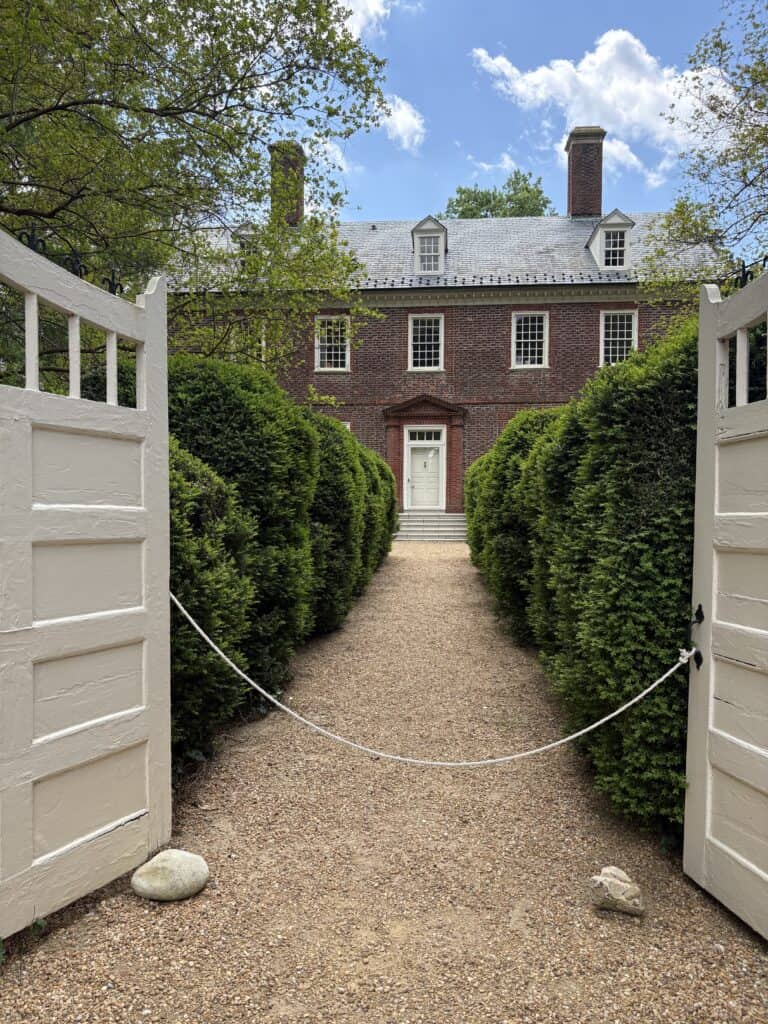
Most of them shared a heritage tracing back to Harrison, and the occasion was his 300th birthday and the 300th anniversary of his preserved home place, Berkeley Plantation.
The timing was ideal given this sesquicentennial year of America’s founding. Celebrating the nation’s 250th anniversary prompted direct descendants from all over the country to converge on the 1,000-acre historic site.
(In an interesting note of history, Harrison was formerly known as Benjamin Harrison V. Even though he did not sign his name as the fifth, this article refers to the signer as Harrison V for clarity given the many famous Benjamin Harrison descendants.)
Texan William Bassett Orr, primary organizer of the event, descends from a Harrison family tree that is oak-like, with sprawling branches. He is the signer’s fifth great-grandnephew. His ancestry is through the live-in nephew, Carter Bassett, of Benjamin Harrison V’s wife, Elizabeth Bassett Harrison.

“We want to remember the founding generation,” said Orr. “They have much to teach us. I look back in awe at their example of sacrifice for the greater good, including the greater good of a distant posterity – us. I look back in awe at their persistence.”
Another contingent of family members attending the celebration hailed from Wyoming representing William Henry Harrison III. He served politically in the 1930’s. He was the great-great-grandson of the ninth president of the same name, the great-great-great grandson of the signer, and the grandson of 23rd president Benjamin Harrison.
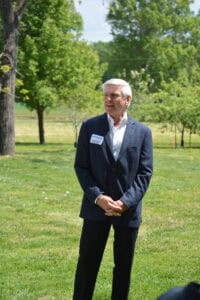
Thus, instead of a tree with many branches, this Harrison family tree resembles a tall, straight poplar – showing direct lineage to the American signer. Other related notables in attendance were Benjamin Harrison’s second great-grandson, John S. Harrison (left), and his nephews, Tyler and John Benjamin Harrison. Their common first names, passed down through generations, reflect the importance of keeping family tradition alive.
Proud and Patriotic Lineage
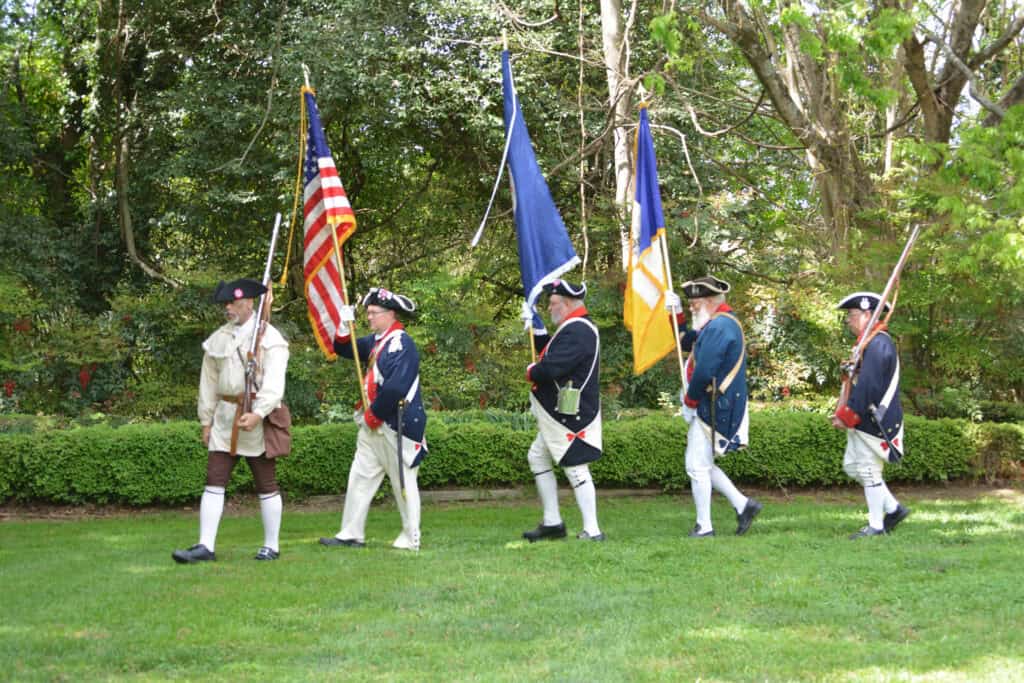
The warm spring day’s launch ceremony took place at the end of Berkeley Plantation’s grand James River approach lawn.
The main speaker was Berkeley Plantation historic interpreter, Crystal Phillips, who recognized Harrison descendants and informed: “[Harrison] was a patriot, a signer, a governor of Virginia, a man who helped shape the nation, but also a man who … had a personality. We forget that the men who built this country were not walking around like portraits … statues. They were real people, talking, laughing, and … stepping up when it mattered most. If Benjamin Harrison was here today, he would not be standing quietly on the sidelines.”
She relayed a famous account of the signer’s wicked wit: When the 6’4”, 250-pound Harrison V was signing the Declaration of Independence, alongside the very slight Elbridge Gerry of Massachusetts, he said to Gerry (where the word gerrymandering originated) that if the Revolutionary War was lost, their signatures on the document would result in their hanging. He joked to Gerry, “With me it will be over in a minute. But you, you’ll be dancing on air an hour after I’m gone.”
Risking life and fortune
Harrison V’s history the talk of the day. He risked his life and fortune to sign his name to our country’s most monumental document and thus committed – in King George III’s, Parliament’s, and British soldiers’ view – an act of treason. He also fathered the ninth president.
President William Henry Harrison died of pneumonia 31 days after his inauguration, thus distinguishing him has having the shortest presidency. In turn, though, he fathered John Scott Harrison, who fathered the 23rd president, Benjamin Harrison.
Therefore, anyone related to the signer or either of the presidents is connected to men who greatly served America, from its true foundations through to the latter part of the turn of the 20th century.
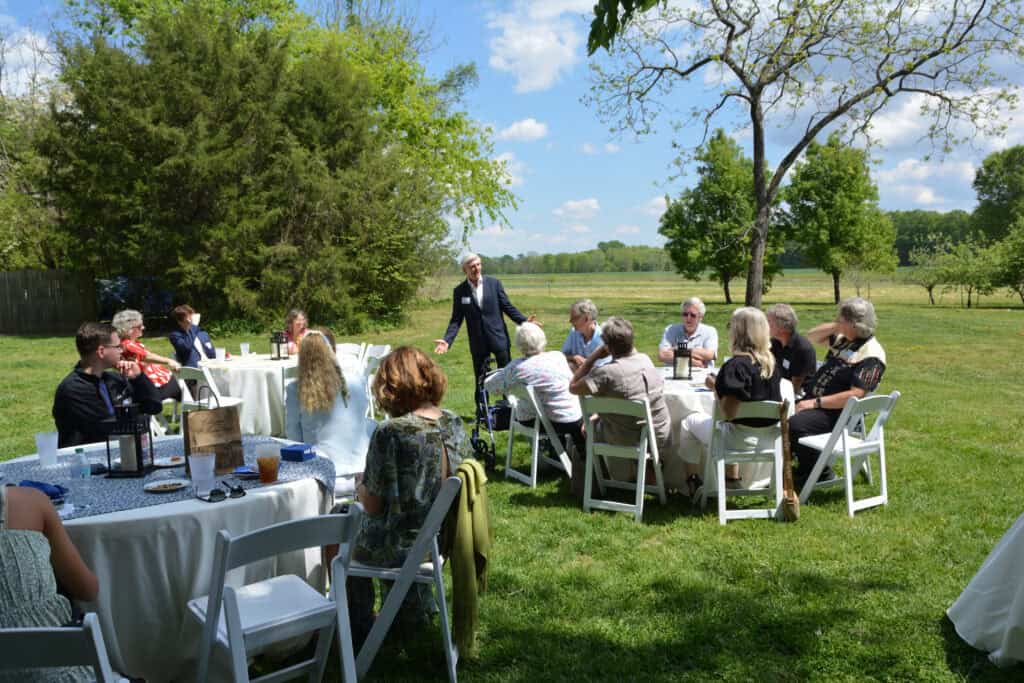
Saturated in Family History
To steep themselves further into their Harrison heritage, Orr and a few family members stayed at the nearby 1801-built North Bend Plantation, established as a bed and breakfast by the great grandnephew of William Henry Harrison, George Copeland II, and his wife, Ridgeley. (She is 88 and continues to operate the bed and breakfast.)
The museum/home is dense with Harrison historic artifacts and books, as well as elements of other important Copeland ancestors, including John Tyler, who was William Henry Harrison’s vice president.
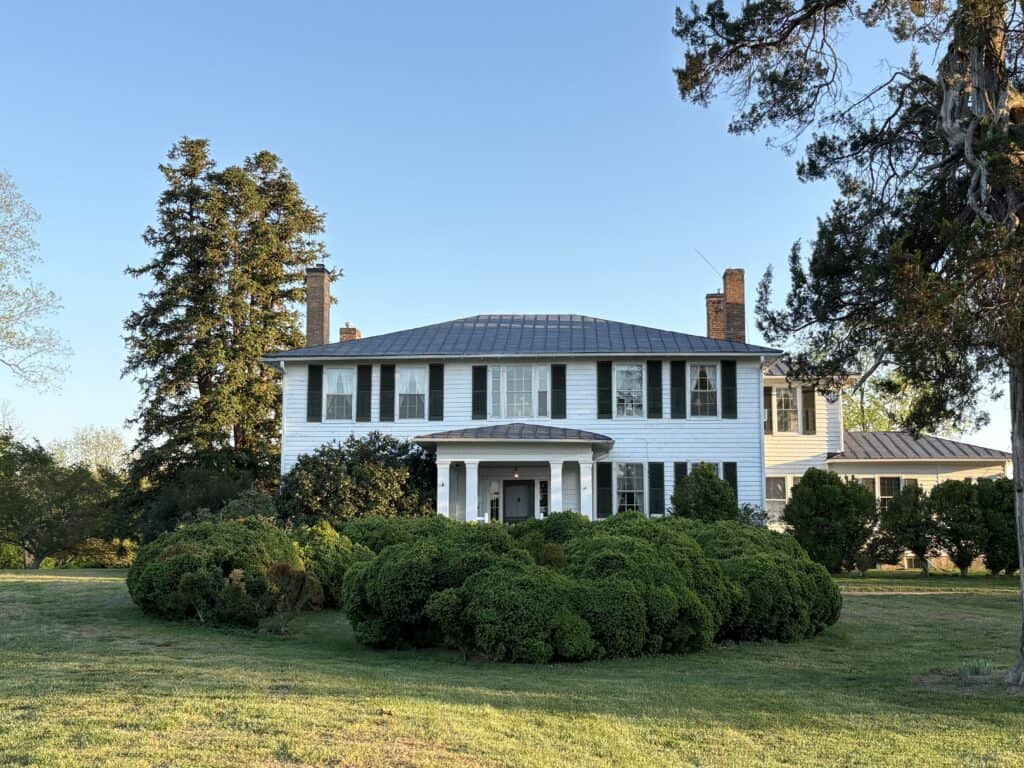
Orr’s nephew, Jack Harter, echoed the gathering’s feelings that staying in the historic North Bend home and attending the event at Berkeley inspired a deeper dive into their birthright.
Carolyn Harrison Scott, named for President Benjamin Harrison’s wife, is currently researching and transcribing some of her family’s old letters; she also inherited First Lady Caroline’s White House dresses and remembers playing dress-up in them as a little girl.
Brothers Tyler and John Benjamin Harrison, from Wyoming, said their grandparents instilled in them the importance of honoring their lineage. Growing up as a Harrison meant they lived American history. As boys, they were told to be careful with Harrison artifacts and furnishings in their homes. “In our family has been a chair from the White House, vases, pictures … so much has been donated [to museums],” said John.
“Being a direct descendent is something that’s always been understood,” said Tyler. “As we’ve gotten older, we appreciate it more.”
Overall, it was evident on April 11 that Harrison V’s American patriotic spirit was instilled from signer through the ages to direct descendants. Many attending the event were currently in or had been in military or political service – and all expressed pride in their family members’ contributions to this country.
Perhaps main reunion speaker, John S. Harrison, expressed their “shared heritage” best: “We realize the sacrifice Benjamin and other signers made. I thought about what Benjamin would say if he was here and could see family members gathered. I think he would look across all of us and recognize that his legacy is alive and well. He would recognize that public service continues. I think that he would tell us that we are the proof of that bold experiment he started so long ago. The Harrison name lives on.”
A tour of Berkeley Plantation and its elaborate gardens is a living history experience – a step back in time to truly imagine 18th and 19th century life. Plus, visitors will learn that not only was Berkeley the origin site for an important American family, but it was where the first Thanksgiving truly occurred, where Revolutionary War traitor Benedict Arnold ransacked the home and burned family portraits and furnishings, and where the military standard bugle song, “Taps,” was written and first played.
This article is the first of several to focus on America’s 250th. Future installments will highlight significant aspects of Macon County’s historical connection to that milestone year, 1776. Please contact us if you have a story to share. We encourage readers to protect, preserve, and share their long lineages with family members, friends, and the public so we never forget the work, sacrifice, and patriotism that established and still sustains this great country.