

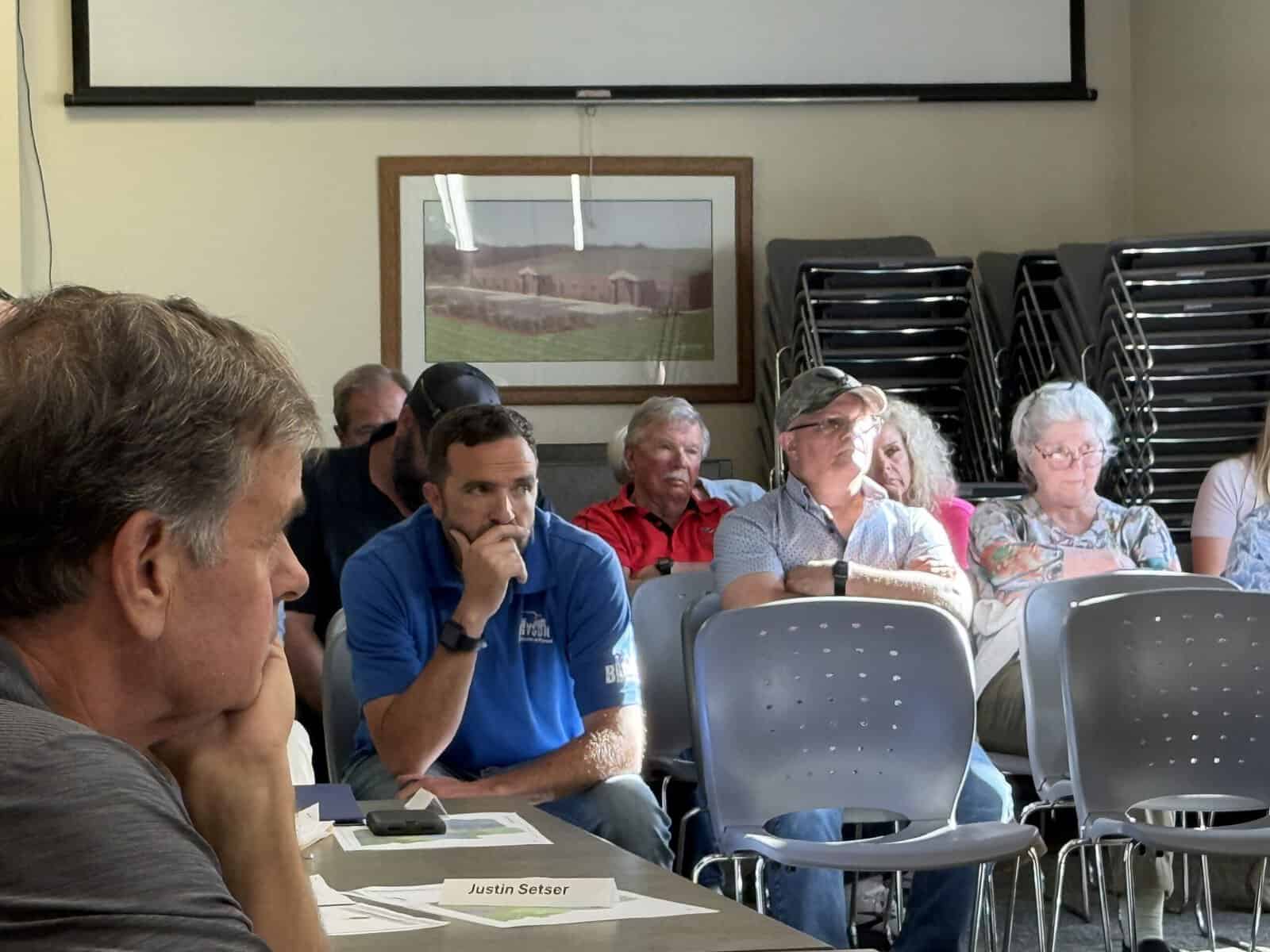

The Macon County Planning Board solicited input from the public on May 7 to shape redistricting efforts for county commissioner seats. A small but thoughtful group of citizens representing different voting districts turned out to share the values they wanted the commissioners to consider.
While there is no general public support for any specific plan, speakers clearly want a change that at least guaranteed fair access, accountability, non-dilution of existing districts, and better representation.
Board members agreed that asking the right questions about “what needed to be fixed” should direct next steps when they reconvene on June 11.
The current system
When Macon County Board of Commissioners Chair Josh Young handed the request to the planning board to review redistricting, he didn’t impose guidelines. All he asked was for public comments to guide the process.

Since 1978, Macon voters operate under a “mixed” system of electing a commissioner per district and two at-large commissioners.
Commissioner John Shearl has repeatedly raised concerns that the system could be found unconstitutional if a legal challenge were filed against the county. He believes voters in District 1 and District 3 are currently disenfranchised based on the frequency candidates from District 2 can run for office. Failed candidates from Districts 1 and 3 must wait four years before competing again.
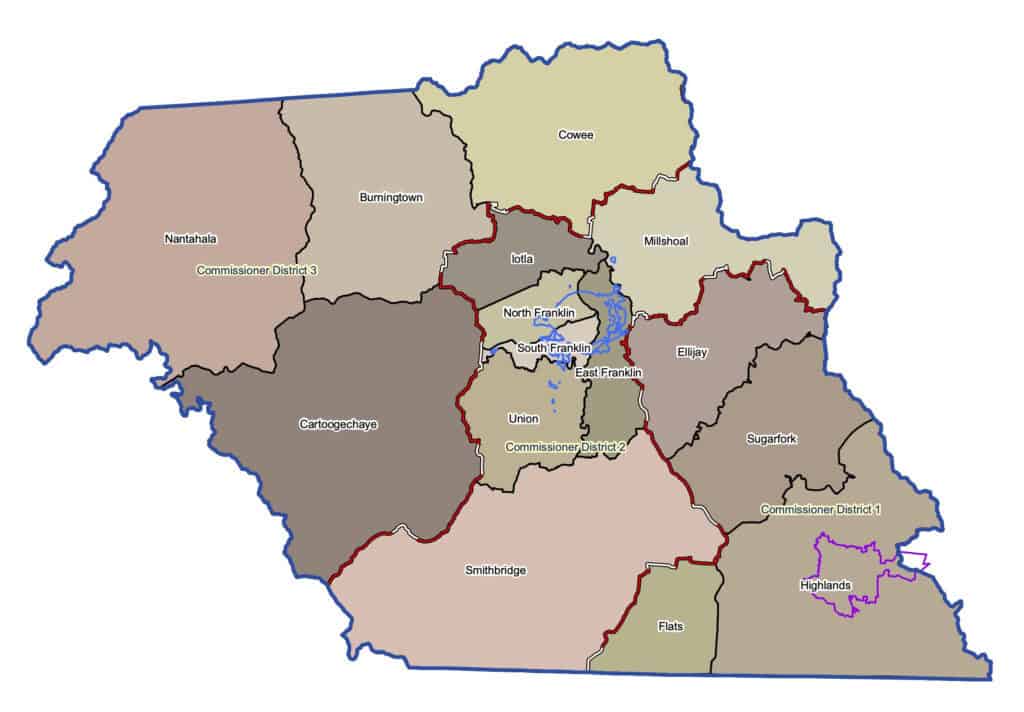
Currently, there are three voting districts:
- District 1 – Ellijay, Sugarfork, Highlands and Flats
- District 2 – Iotla, Millshoal, Union, Smithbridge, East Franklin, North Franklin and South Franklin
- District 3 – Nantahala, Burningtown, Cartoogechaye and Cowee
All commissioners serve four-year terms. The election of one at-large seat, currently filled by Josh Young but listed as a District 2, and Barry Breeden’s District 3 seat are during presidential election years. Their next election is 2028.

The elections for the remaining seats – District 1, District 2 and the at-large seats listed as District 2 – are in “off years” like this year which is not a presidential election year, but does include Congressional elections. Because of the staggered at-large elections, it appears that District 2 candidates get to run more often than the other districts.
And oddly, all county voters vote for all commissioners whether they live in the district or not. Therefore, voters outside of Districts 1 and 3 vote for those representatives too.
Options mentioned for “fixing” the system vary from creating five distinct districts with only those residents voting for those district representatives or a “3-2” configuration dividing up all the districts in to three and leaving two at-large representatives. Nothing is set in stone now.
The public speakers
The public speakers agreed that varying fixes have pros and cons, but most advocated for more regular and direct contact with their elected representatives to ensure local concerns were conveyed to their commissioner.
- Constance Neely of Scaly Mountain – “I want my representative to live near me and know me and my neighborhood.”
- Jimmy Goodman from Franklin – “Do not try to throw politics in your debates on this. This is making sure that every single person gets represented the same way for every single district.”
- Lisa Walker, also of Franklin – “We could keep District 1 and District 3 the same … and then just take District 2, which is the most populous, and split up into 3 areas” for single district representation.
- Rob Tolp from Franklin – “It only makes perfect sense that voters from each district be the ones who choose the commissioner in that district, but it also perfectly aligns with our founders’ vision and original structure of representative government. The current district lines right now do not get equal representation.”
- Ryan Bryson of Scaly Mountain (pictured top) – “My concern with going to three equal districts is that we’re going to dilute how much, how big our area is. It’s important that we keep our districts with our smaller groups.”
- Tony Potts from Highlands – “I think the fairest for the whole county is for each district to vote on its own representative. So, whether we go to three districts, whether we go to five districts, whatever it is, I believe that district should vote on that, should vote for their representative.”
Turn the volume down, fix a broken system
When asked about current statutes and population numbers, Eric Ridenour, the county attorney, said under the 2020 Census Macon County remained in compliance with roughly 7,000 voters in Districts 1 and 3 and 22,000 in District 2 with the at-large system in effect.
Assuming the county kept only three districts, Ridenour said, “I don’t know how you could do it any better unless you were to start changing townships and that probably wouldn’t be good.”
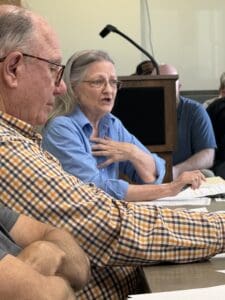
During the board discussion, Town of Highlands representative Amy Patterson introduced three options for creating five electoral districts. She asserted her plan would not dilute current districts and give voters direct representation.
“I totally agree that the most fair way to do it is for every district to elect their own representative and not have the at-large,” she said.
Patterson and Shearl debated the interpretations of state supreme court decisions that govern redistricting. Board member Marc Hehn finally interjected, “Turn the volume down. We’re not voting for anything right now.”
Shearl noted when the idea of redistricting was brought up in late 2025, he had hoped to move fast enough to have a new system in place for the 2028 election cycle. But given that the General Assembly would need to approve a new system in 2027 or voters decide through a referendum, a resolution isn’t likely until the 2030 cycle.
At one point, board member Marty Kimsey noted, “We’re not doing anything because it’s not up to us. We’re here to kick this ball around and keep it up in the air. We can make the recommendation, but I strongly suggest that each of the members of this committee chitchat with commissioners on an individual basis.”
As planning board Chairman David Culpepper quipped near the end of the meeting, “All of these plans have fleas. You just have to pick the best one.”