


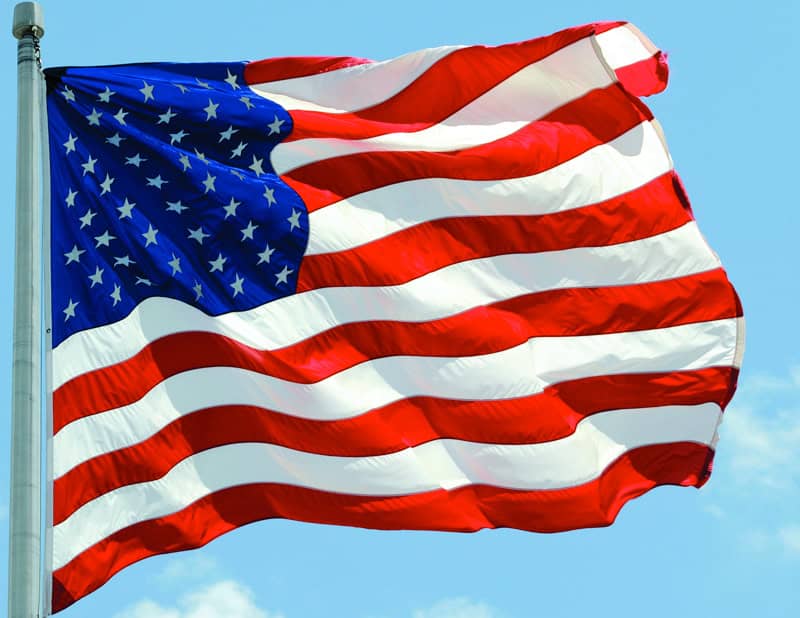

“You’re a grand old flag,
You’re a high-flying flag
And forever in peace may you wave.
You’re the emblem of
The land I love.
The home of the free and the brave.”
Flag Day is Sunday, June 14. Perhaps at no other time in the last century – except for 1976 – has the flag, as a symbol and anchor of our country, been so prominent and important as America’s 250th milestone anniversary.
Memorial Day, Flag Day, Independence Day (the biggie), and Veteran’s Day are the high point holidays when the American flag has been, and will especially be this year, proudly displayed on poles, clothing, home décor, jewelry, and more.
In Macon County this weekend, the American flag will be honored in songs and at public ceremonies and private events. Specifically, 828 Vets is hosting Fresh Flag for Flag Day on Saturday, June 13, at Appalachian ACE Hardware on Palmer Street. Bring a worn-out or tattered flag beginning at 8 a.m. that day and receive a brand-new flag. This event will last until all the flags are given out.

Additionally, American Legion Post 108 in Franklin has a year-round drop box for retired flags. Periodically, flag retirement ceremonies are held.
Symbol of freedom, and our nation
Even before the first official American flag was flown in 1777, two years after the “shot heard round the world” occurred at the Battles of Lexington and Concord in Massachusetts to launch what became the Revolutionary War, protest flags against Britain were sewn and carried or displayed. Some just touted the word “Liberty,” while the most famous antagonistic flag became the one of a snake cut into pieces, representing different colonies, and the words “Join or Die.”
According to the National Flag Foundation, the original official flag sporting 13 stars and 13 stripes to represent the 13 colonies was approved by Congress on June 14, 1777. Thus, June 14 became Flag Day.
As more states were added over the next two centuries, stars increased to 50 on the flag. In fact, the 50th star was added in 1960, when Hawaii became a state. However, the flag maintains its 13 stripes as a reminder that the country had humble beginnings.

Throughout our history of conflicts, men and women have died carrying the American flag. Most notably, during the War of 1812, a man named Francis Scott Key was an American lawyer and amateur poet who witnessed the British bombing of Fort McHenry in the Baltimore Harbor.
As the story goes, when the smoke cleared, Key expected to see the British flag flying over the fort; yet, the American flag remained. Four Americans were killed and 24 were wounded during that battle.
He penned the poetic words of “The Star-Spangled Banner” on an envelope he found in his pocket. Eventually set to music, the song became in 1931 our National Anthem.
The American flag’s distinction as the enduring sign of strength, patriotism, and freedom – known globally – was solidified in Key’s words:
“Oh say can you see by the dawn’s early light
What so proudly we hailed at the twilight’s last gleaming?
Whose broad stripes and bright stars through the perilous fight,
O’er the ramparts we watched were so gallantly streaming?
And the rockets’ red glare, the bombs bursting in air,
Gave proof through the night that our flag was still there.
O! say does that star-spangled banner yet wave
O’er the land of the free and the home of the brave”
Throughout other wars, including at Fort Sumter, S.C., in 1860 at the start of the Civil War and at Hickam Air Force Base in 1941 during the Pearl Harbor attacks, the American flag has endured. In museums all over the country, historic flags flown during conflicts have been preserved and are exhibited to convey this country’s fortitude.
Astronauts installed a flag on the moon, we cover our hearts and face a flag at the beginning of every sports event and government meeting, and it flies prominently on porches, from truck beds, and in front of businesses.
From Franklin to Arlington, one flag, one nation
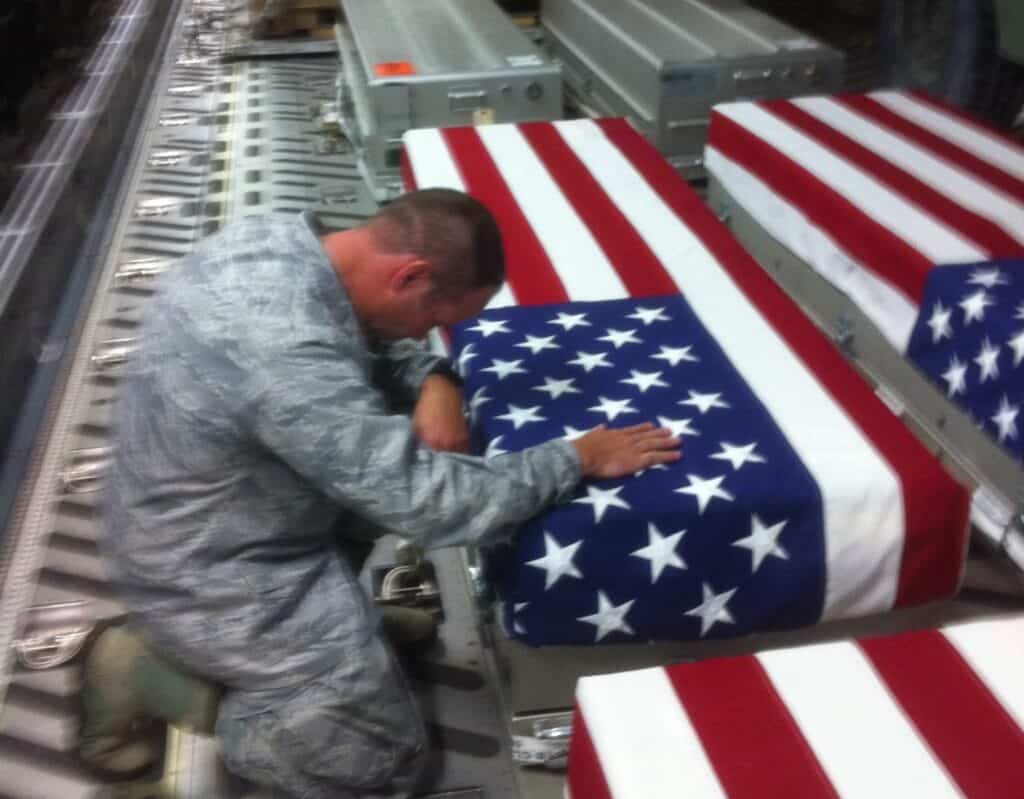
Ceremoniously, it is also draped over the coffin of fallen military soldiers and sailors, and it is then properly folded and presented to a loved one.
Local Lt. Col. Matthew McMurty remembers the day the flag became a visceral symbol of not only his service in the U.S. Air Force, but also what it meant to be an American. His best friend had been killed an Afghanistan.
“I spent countless hours with that flag-draped casket, from Germany to Dover, Del., and then to Colorado, and then back to D.C.,” he said. “Every time it was taken off the plane, I saluted it. It was a very emotional time, but I would never have turned that down. It was an honor.”
He added: “A very powerful quote by [American priest] Father Dennis E. O’Brien (1923-2002) that really speaks to me about my service in the military and about the importance of the American flag is this: ‘It is the soldier, who salutes the flag, who serves under the flag, and whose coffin is draped by the flag who allows the protestor to burn the flag.’”
McMurtry has volunteered to put flags on the graves at Arlington Cemetery, where his friend is buried. He periodically flies a flag at his cabin; and, he stops to put his hand over his heart each time he is on a military base and the National Anthem is played during “Morning Colors.”
Let us make certain that Flag Day does not pass without considering the importance of the American flag’s history. May we purpose to honor and respect our country’s most prominent patriotic symbol.