


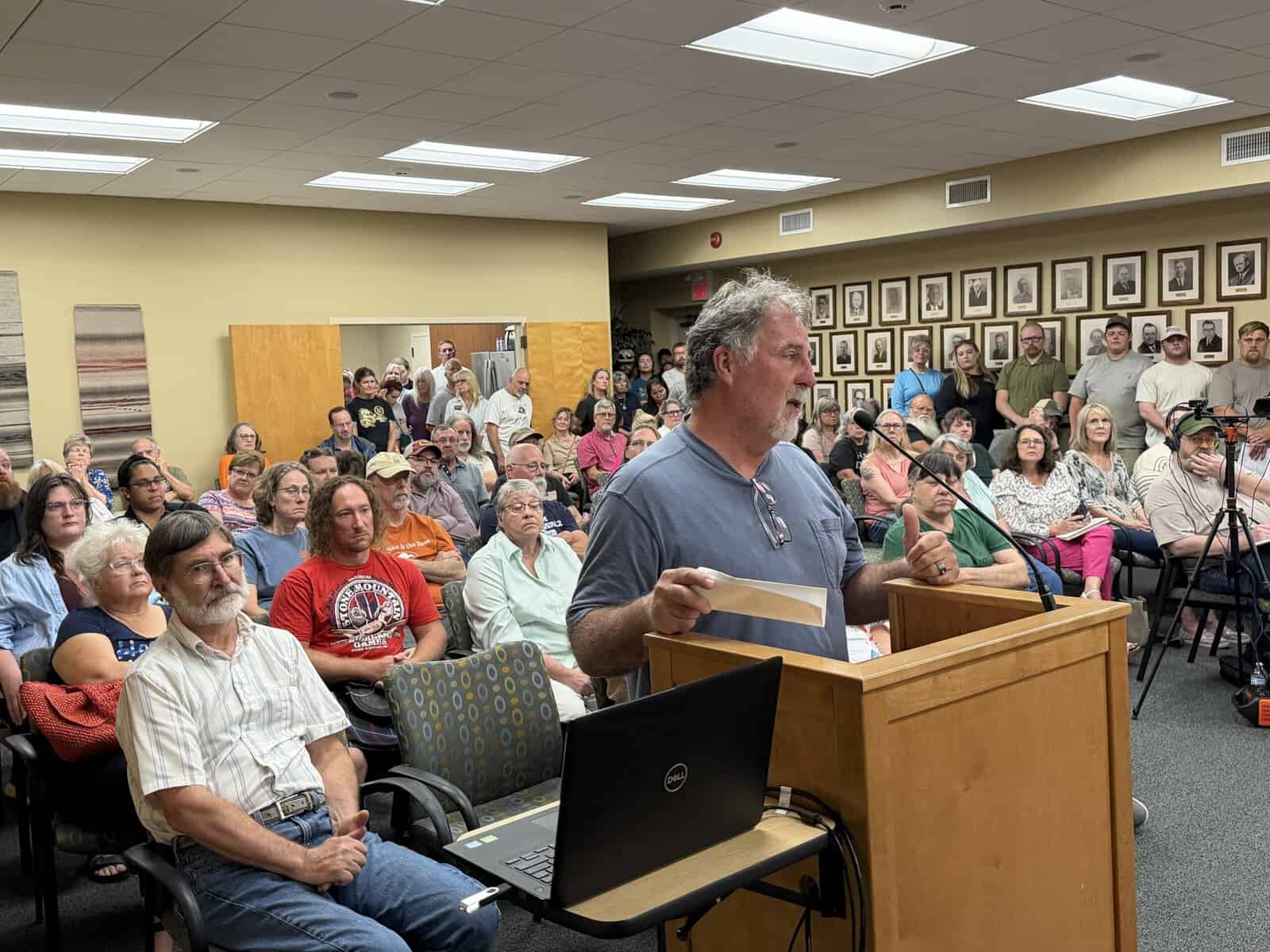

To the applause of a room packed with citizens who spent nearly an hour voicing their opposition to data centers, Franklin’s town council unanimously voted for a one-year moratorium on data center development within town borders.
A nearly overflow crowd of 118 people packed the Council chambers to express their firm opposition to data center development.
“This is the most people we’ve had at a town council meeting,” said Mayor Stacy Guffey in his opening remarks. “A roomful of people who are here because they support what we’re getting ready to do tonight. I appreciate you give a damn about your community.”

Many observers arrived assuming council members were on the fence over the issue and were surprised to find a council united in support of the moratorium and willing to find all available legal avenues to keep data centers out of Franklin.

Why now?
Introduced for formal discussion in June, Town Attorney John Henning, Jr. said the Town’s Unified Development Ordinance lacked proper definitions of data centers and the potential impacts on noise abatement, water usage, and electrical infrastructure.
“If someone showed up with a zoning application before adoption of the moratorium, we would be in tough spot to prevent it,” Henning said.
One audience member yelled out, “If? That sounds scary, brother!”

In absence of specific regulations, Henning raised the prospect that data center developers might be drawn to Franklin to take advantage of a loose regulatory structure at a time when other cities across North Carolina were imposing moratoriums.

Franklin defines a data center as “an establishment engaged in the storage, management, processing, and/or transmission of digital data, which houses computer and/or network equipment, systems, servers, appliances, and other associated components related to digital data operations, including the operation of a server farm and/or cryptocurrency mining.”
Emotional discussions
To gauge local sentiment, the council set aside time for a public hearing so residents could air their views. Sixteen speakers raised concerns about the impact on the environment, wildlife, water quality and energy usage.
Several speakers detailed their experience working in information technology, offering statistics about the potentially negative effects data centers could have on quality of life, tourism, and the economy in Franklin.

Theresa Salisbury, a recent transplant to Franklin, gave an emotional speech about her love for her new home. She said a data center ruining the local environment was “devastating and scary.” She hoped to leave her house to her grandchildren and she was speaking out to preserve the future for them.
In an exchange with Michelle Montegut, Henning said a moratorium could last longer than 12 months, but it could only be extended to complete the review process and make changes to applicable regulations within the town limits. Montagut asked how the city would research data center impacts on the health and welfare of communities that already host them.
Henning responded that Franklin will band together with other communities to look at issues, share resources, and share best practices as the city undertakes its review.
There was universal agreement that residents must share their concerns with county commissioners and state representatives.
“These decisions belong here, not in Raleigh. We should have control over our communities,” noted David Medlock.
Speakers exhorted the council to outright ban data centers, but council members explained that state legal requirements restricted their actions at the local level.
Mayor Guffey promised to make it “virtually impossible” to build a data center in town.

How Franklin’s moratorium works
With the moratorium going into effect July 6, Franklin will now “suspend the acceptance, processing, and approval of development applications for new data center developments within the Town of Franklin and its planning jurisdiction.” This will allow the Town sufficient time to:
- Evaluate the impacts of data center development on public infrastructure and municipal services;
- Review utility capacity, including electrical and water infrastructure;
- Develop appropriate zoning, buffering, landscaping, noise, lighting, and operational standards;
- Evaluate environmental and stormwater impacts;
- Consider amendments to the Town’s UDO and Comprehensive Plan; and
- Protect the public health, safety, and welfare pending completion of such review.
After the meeting, Hennning said while there are no active applications for data centers in Franklin, the comprehensive review could start immediately and would involve the town’s planning board, among other entities.
Franklin has not coordinated or exchanged information with Macon County’s attorney, but he assumed the two would coordinate in the near future.
County considers closing loopholes, no ban proposed
While the town took a broader, oppositional stance to launch its efforts to fight off data centers, the county’s planning board members, on July 2, voted to take a more measured approach.
Planning Director Joe Allen said the county undertook an extensive review of data centers and amended its ordinance in June 2023. Then, the goal was to prevent similar noise, electrical usage, and property value issues residents in Murphy experienced after a cryptocurrency mining facility opened.

He said that with the new developments across the country, Eric Ridenour, the county attorney, began performing due diligence and scouring county ordinances on data center regulations in May.
To clear up any confusion, Allen said these facilities are already being regulated in Macon County, but Ridenour feels like the ordinance’s language “left some wiggle room” that needed to be addressed.
Allen then introduced suggestions to amend the High Impact Land Use ordinance to address existing loopholes.
Currently, the county regulates hours of operation, noise levels, power, and water usage, but does not outright ban the facilities if they can meet specified requirements.
The intent of the amended regulations would focus solely on centers generating artificial intelligence, cryptocurrency mining, or data processing. Current businesses operating server rooms for regular operations, such as hospitals, would not be impacted.
The proposed redlines and language would include the term “data centers” and “server facility” to reduce any ambiguity, and to aid the county in fending off nuisance lawsuits if permit applications were declined.
At this point, Allen also said there were no requests by potential developers, but, “these places look for communities with no zones and low tax rates.”
With so many other communities in North Carolina imposing moratoriums on development over the past year, additional county actions would be “pro-active” to stave off potential misunderstandings of the county’s original intent on regulation.
The board agreed to allow more time for David Culpepper and Mark Hehn to review proposed changes before the August 6 meeting.