



Sometimes the most meaningful stops on a journey aren’t the ones you planned.
I was in Charleston this past May for other reasons when I realized I was only minutes away from The Citadel.
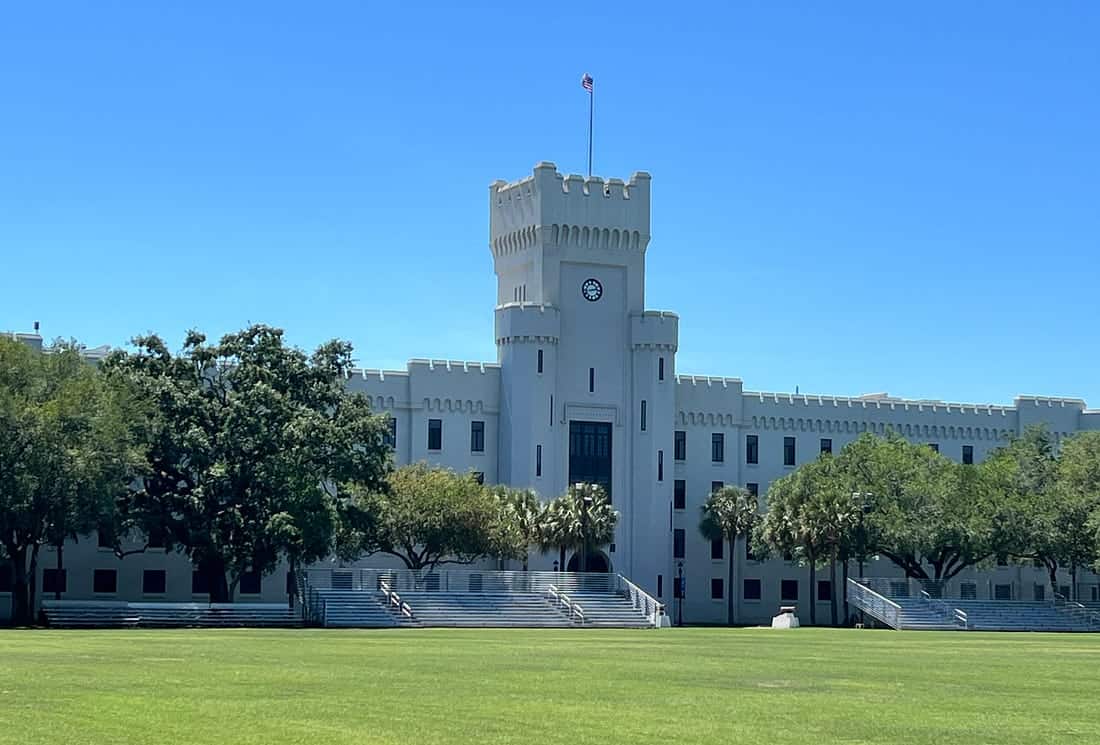
Before leaving home, my friend H.E. “Chunk” Neale – a proud graduate of the Virginia Military Institute – encouraged me to carve out time to visit the Citadel (pictured above).
It proved to be excellent advice.

I expected to learn more about one of America’s oldest military colleges. I left pondering something much larger: the enduring value of institutions dedicated not simply to educating students, but to developing leaders.
Founded in 1842, The Citadel has spent nearly two centuries preparing young men and women for lives of leadership and service.
That mission comes alive inside the school’s Archives and Museum. It is far more than a collection of artifacts. It is the story of generations who accepted demanding standards, embraced personal discipline, and understood that leadership begins with character.
One exhibit that especially caught my attention recreated a cadet room from an earlier era. The beds folded neatly into large wooden cabinets during the day. Living quarters were simple, orderly, and purposeful. Every item had its place. It wasn’t difficult to imagine generations of cadets learning lessons that extended well beyond the classroom.


Elsewhere were Civil War letters written in fading ink, uniforms spanning nearly two centuries, class rings representing generations of graduates, and the original instructor’s desk from the old Citadel campus on Marion Square.

Outside stands the monument commemorating the firing on the Star of the West in January 1861, one of the opening military events leading to the Civil War.

Nearby sits an AH-1 Cobra attack helicopter honoring Citadel aviators who served from Vietnam through later conflicts.
None of these exhibits glorify war. Instead, they tell the story of service, sacrifice, and an institution that has remained remarkably faithful to its mission while the world around it has changed dramatically.

Walking the campus, my thoughts naturally turned home to Virginia.
Virginians have long taken pride in the Virginia Military Institute in Lexington. Founded in 1839, VMI and The Citadel are the nation’s two oldest Senior Military Colleges.
They have developed distinct traditions, spirited rivalries, and generations of fiercely loyal alumni, yet they share the same philosophy: leadership is earned through discipline, rigorous academics, physical fitness, accountability, and an uncompromising honor system.

VMI has produced military leaders, governors, members of Congress, business executives, educators, scientists, and public servants whose influence extends far beyond Virginia.
The Citadel has done the same for South Carolina and the nation. Their graduates have served with distinction in every major American conflict while also leading companies, classrooms, courtrooms, hospitals, and communities.
They are joined by four other federally designated Senior Military Colleges. Together with America’s five federal service academies – including West Point, Annapolis, the Air Force Academy, the Coast Guard Academy, and the Merchant Marine Academy – they represent one of the most successful leadership-development systems anywhere in the world.

Of course, not every graduate enters military service. That misses the larger point. These institutions prepare officers, but they also graduate men and women who carry the habits of discipline, accountability, resilience, and service into every profession they choose.
During the past year, we have all reflected on our nation’s founding while celebrating the 250th anniversary of American independence. Studying the Revolutionary generation naturally leads to an enduring question: Who will preserve those ideals during America’s next 250 years?
The answer will not be found in monuments alone.
It will be found in families, churches, civic organizations, and educational institutions that continue forming citizens of character.
Higher education serves many worthy purposes. It advances research, expands knowledge, prepares students for careers, and drives innovation.
Military colleges and service academies do all of those things while adding something that has become increasingly rare: an intentional commitment to developing leaders who understand that freedom carries responsibility, authority requires humility, and service to others is one of life’s highest callings.

I left Charleston impressed by The Citadel’s beautiful campus and outstanding museum. I left even more appreciative of the role America’s military colleges and service academies continue to play in preparing leaders for our nation.
America has now begun its next quarter millennium. Preserving historic battlefields, museums, and landmarks will always matter. So will preserving institutions that prepare each new generation to lead them.
In an era when leadership is frequently discussed and often questioned, The Citadel, VMI, our other Senior Military Colleges, and the federal service academies quietly continue doing what they have done for generations: challenging young Americans to become their very best.
That is a tradition well worth preserving.