




The Town of Franklin is investing in its future by upgrading its water treatment plant and expanding the plant’s capacity. And, at just over $6.6 million, the project will quadruple the town’s treated water availability to residents, businesses and visitors.
How is that accomplished? Specifically, the project is replacing and expanding the plant’s “clearwell” storage, and its pumping capacity by updating two end-stage water service pumps with three new high service pumps.
“This investment gives Franklin greater water capacity, added redundancy in the system, and better protection during drought and flood conditions,” said Mayor Stacy Guffey.
In all, storage capacity will increase from 56,000 gallons to 250,000 gallons of treated water.


Many residents are familiar with the occasional, temporary water restrictions placed on local customers while maintenance and upgrades are performed. The past restrictions generated complaints, but residents and businesses will soon realize that the Town’s investment will benefit current and future customers, and reduce existing limitations.
“Most folks don’t think much about their water system until there’s a problem, and that’s exactly how it should be,” said Franklin’s Mayor Stacy Guffey.
With a completed expansion in reach, restrictions and complaints may become a thing of the past.

Bigger and better
Built in 1975, Franklin currently owns and operates the water plant as a government-provided service. While many of its original components are still in use, the town decided in 2022 it was time to replace parts and machinery at or near their life-cycle, and expand its capacity to meet customer demands.

Currently, the plant processes and delivers two million gallons-per-day for local customers. The three new pumps added to the plant can deliver four million gallons per day each.
Here’s how the system works:
- Water is drawn from Cartoogechaye Creek and pumped up to the plant for a two-phase filtering and purification process.
- After that two-phase process is complete, water is stored in a clearwell and available to be sent out to customers using an additional set of pumps.
- A clearwell is the final storage basin in a municipal drinking water treatment plant, designed to hold filtered, hence clear, and disinfected water before it is distributed to consumers.
One of the advantages to the expansion is the town can perform maintenance while meeting the needs of its customers.
“Right now, we are barely creeping by on our current capacity and what maintenance we can do, we have to do at night in order to minimize impact on residents’ water availability,” explained Kyle Pocquette, the plant’s Operator in Responsible Charge (ORC).

Pocquette provided a tour of the water treatment facility, which is located within the Industrial Park Loop west of Franklin. Haren Construction Company is working on both the high service pumps and clearwater well. And, the work is significant on every front, not just storage and pump capacity.
“The two existing pumps are only 50 horsepower (hp) each. There will be three 125 hp high service pumps and an internal crane system, located within the new building, that can be used to pull pumps when necessary. There will also be two additional backwash pumps that will help us clean our filters. Currently, we rely on gravity to do the cleaning.”
Temporary piping has been installed around the facility while the project is being completed. Water service continues, which includes pumping as far east as the Franklin Ford dealership and as far south as the Macon County Welcome Center on Georgia Rd.
Turbidity impact
Besides pumping and storage, the plant, of course, cleans the water to make it potable or drinkable. For Pocquette’s team, turbidity, the measure of water clarity, is a daily challenge.
High amounts of turbidity make water appear cloudy or murky. Reducing the turbidity is the focus of Pocquette’s entire operation at the treatment section of the plant.
“When you drive by a river and it appears orange, it’s dirty. We have to take all that out, which can make our job extremely difficult. On a normal day, our job is relatively easy. We get paid for the muddy days,” said Pocquette.

The entire process begins by retrieving water from Cartoogechaye Creek, which is sent up to an initial pre-treatment chamber system that removes approximately 90% of the turbidity. This part of the process utilizes silica as the primary filtering medium used to trap physical impurities into what are called flocs – essentially larger clusters of impurity particles. The role played by silica reduces the need for more chemical components to accomplish the mission.
Centrifugal force is used to help impurities coagulate and be removed from the water. Involved in the purification process is sodium hydroxide, which raises water’s pH (potential of hydrogen) level; poly aluminum chloride, which assists with coagulation/filtering; and bleach, which is used as a disinfectant.
Pocquette said that by the end of this process, turbidity is reduced down to .6%. Water then goes through a final filtering process involving settling basins.
Once the current project is complete, the plant’s next phase of modernization will involve the settling basins being updated, including two additional filters for a total of four. At this time, the plant can only legally process a million gallons per day, per filter.

Past to present
Town Manager Amie Owens provided some of the history and content of the undertaking to improve Franklin’s water treatment output.
“The primary purpose for this project is to rehabilitate and improve the existing WTP (water treatment plant) to ensure an uninterrupted supply of clean and safe drinking water for the residents of Franklin,” said Owens.
The clearwell is an important aspect of the expansion. As the final storage basin in a municipal drinking water treatment plant, having more capacity to hold filtered and disinfected water before it is distributed to consumers means more for those customers. Franklin’s new plant capacity of 250,000 gallons allows for one-quarter of the daily water capacity to be readily available on site for system distribution at all times.

Currently, if maintenance needs to be completed at the plant, the Town must issue water restrictions to its customers, because treating water would need to be suspended during the maintenance period. With the new clearwell, restrictions could virtually be eliminated due to storage capacity increases.
An additional benefit with the upgrades is that the increased capacity could provide potable water resources in the event of a natural disaster.
On time, within budget
Owens said the project is progressing on schedule with few delays or changes, in part due to the contractor, Haren Construction, the engineering team at Withers Ravenel, and the Town meeting regularly to ensure there are no unforeseen issues and to discuss any supply chain issues that may impact timing.

“Only one unexpected repair was necessary at the plant because a piece of equipment breached a main water line. However, the contractor made prompt repairs, and service was restored within a few hours,” Owens stated.
The $6.6 million project, which began back in January of this year, includes a $2 million federal investment. It is due to be completed by late February 2027. That timeline is only two weeks longer than the original estimate provided in 2022.
Emphasizing her and the Town’s satisfaction with both the breadth and speed of the upgrades, Owens concluded with some positive feedback on the project overall: “The fact that only a two-week extension has been requested thus far makes this one of the most successful large-scale construction projects in several years.”
Guffey also said, “I’m grateful for the hard work and dedication of the people behind the scenes who make projects like this possible. This upgrade will benefit the people of Franklin for many years to come.”
Guffey added “Kyle Pocquette, Public Works Director Bill Deal, and the other staff have done an outstanding job managing this project while continuing to provide reliable service every day.”
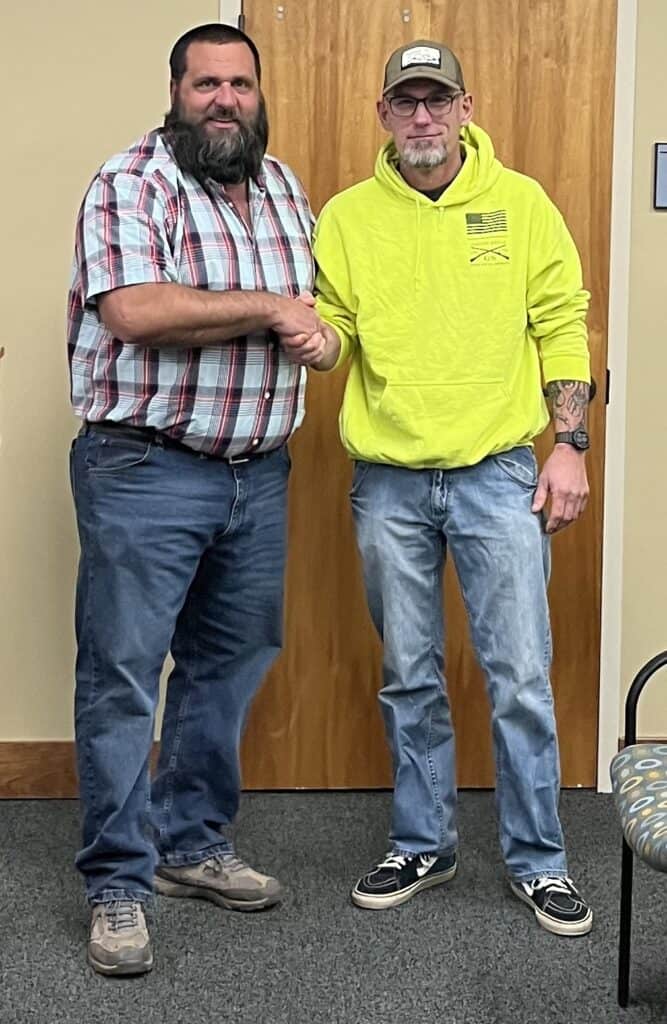
Within the trenches at Public Works, Deal and Pocquette monitor work being conducted, as well as ongoing daily operations.
Said Deal, “One of the successes of this project so far is it actually being completed. The Town has had need of this [newer/larger] clearwell for some time now. While there is always going to be unforeseen issues that arise during any project, our Water Plant ORC has great oversight and is able to adapt to any issues or delays that may arise. This project will ensure that we are up to date and ready for any future water needs.”
Concluded Pocquette, “Whenever construction occurs on an older facility, challenges are likely to arise. However, the Town, and the construction team have collaborated effectively to minimize potential problems, and I am confident the project will be finished on time.” And, currently, within budget.