

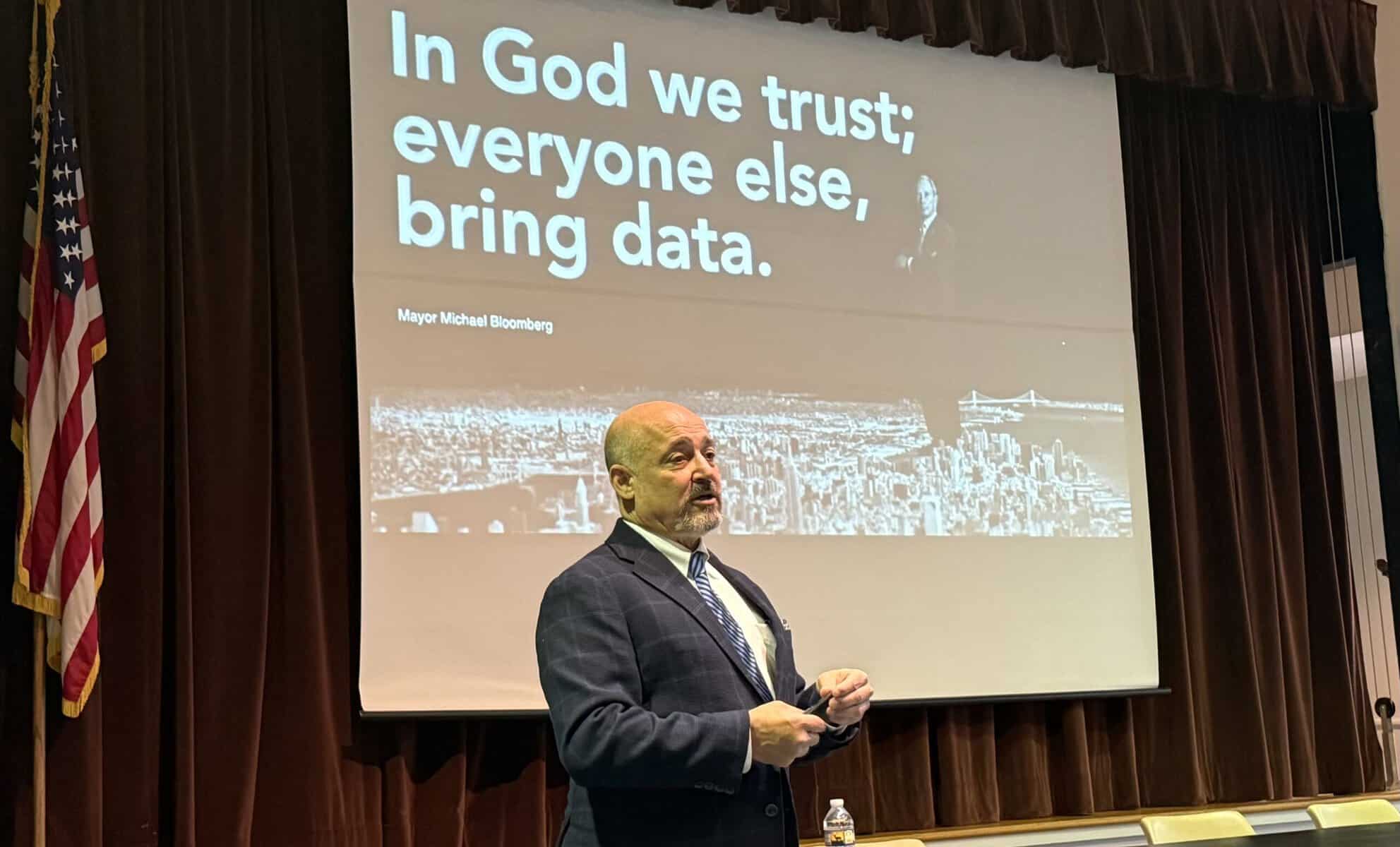

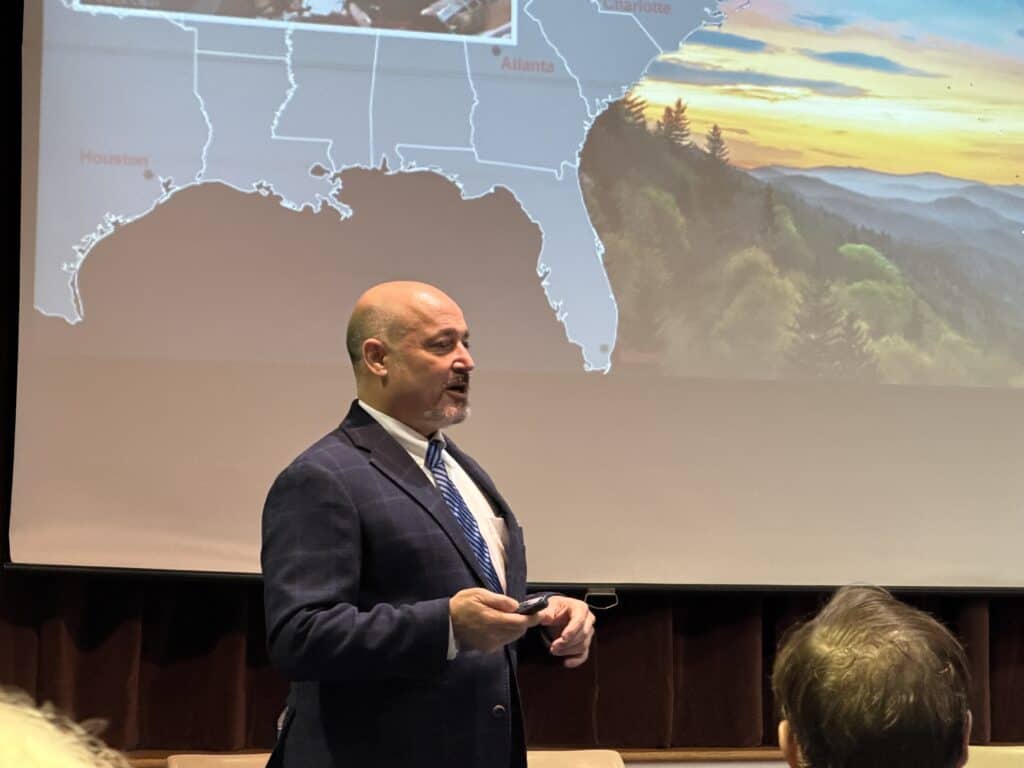
At a special presentation Tuesday, economist Joe Minicozzi argued that Franklin’s historic downtown is one of Macon County’s strongest economic assets, but still has significant untapped potential.
The evening public presentation was part of a full day of community meetings where Minicozzi met with local leaders, building and business owners. That night shared findings from the “Why Downtown Matters” initiative, a data-driven community planning project designed to help residents understand information that rarely becomes part of public discussions.
During the hourlong presentation, he explained how compact, walkable downtown development generates far greater tax productivity than low-density growth and why development patterns have a direct impact on a city’s long-term financial health.
Measuring the value of land
Minicozzi, the founder and principal of the consulting firm Urban3, analyzes the economic productivity of cities compared to typical sprawling community commerce areas. His team works with communities across the United States, Canada, Australia and New Zealand to examine how land use, and infrastructure impact local government finances.

After explaining the methodology behind the analysis, Minicozzi turned to Franklin’s numbers.
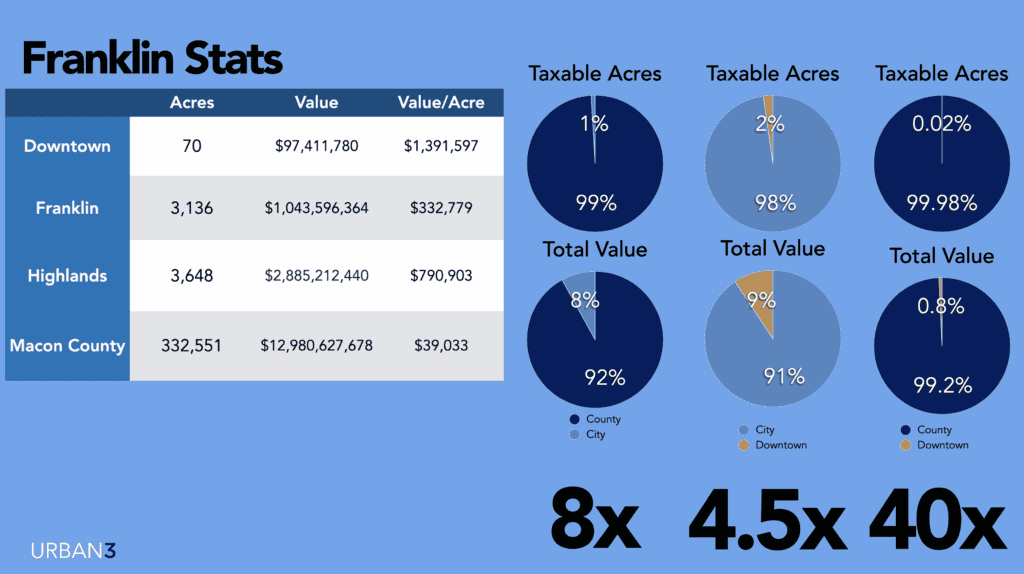
According to the study, Franklin’s Main Street District covers about 70 acres and contains more than $97 million in taxable value. The Town of Franklin’s total taxable value is approximately $1 billion, while all of Macon County accounts for roughly $13 billion.
Minicozzi said those figures demonstrate the outsized economic contribution of the city’s small historic downtown. Urban3’s analysis found that while downtown Franklin has considerable room for growth, it is already one of the county’s most productive generators of taxable value.
“Your downtown is really killing it for the county,” Minicozzi said.

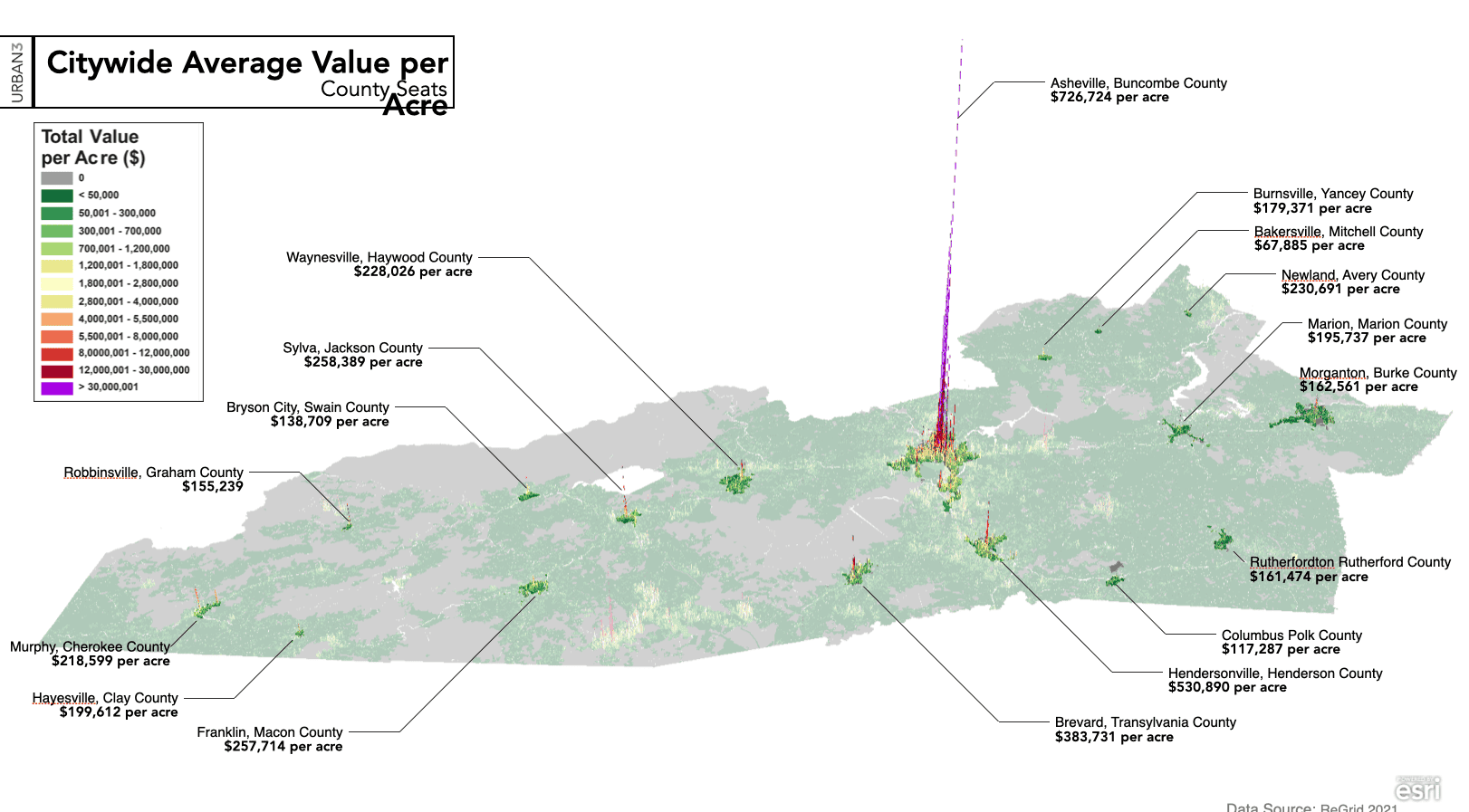
At the same time, he said Franklin’s downtown is not yet reaching what Urban3 considers an ideal level of productivity relative to the rest of the town. Minicozzi pointed to a benchmark ratio of 1-to-6, suggesting Franklin still has room to strengthen the economic role of its historic downtown.
“Your downtown is a little underperforming right now,” he said.
Healthy downtowns, healthy communities
A central message of the presentation was that the financial health of any community begins with a healthy downtown. “You have to have a healthy downtown,” Minicozzi said. “Every square inch is sacred.”
Throughout the presentation, he shared examples from communities across the country to illustrate how compact development produces higher tax revenue, requires less infrastructure, costs less to maintain and creates more opportunities for small businesses.
“His presentation was eye-opening on how downtown’s density can be the retail leader in revenue per square foot. A vibrant downtown leads to expansion of other nearby areas,” noted Steve Grissom, owner of the River Green Condominium development and a member of the county economic development committee.
As one example, he compared traditional downtown blocks with large-format retail stores such as Walmart. While a single Walmart may occupy 15 to 20 acres, he said it often produces less financial value per acre than a traditional mixed-use downtown block.
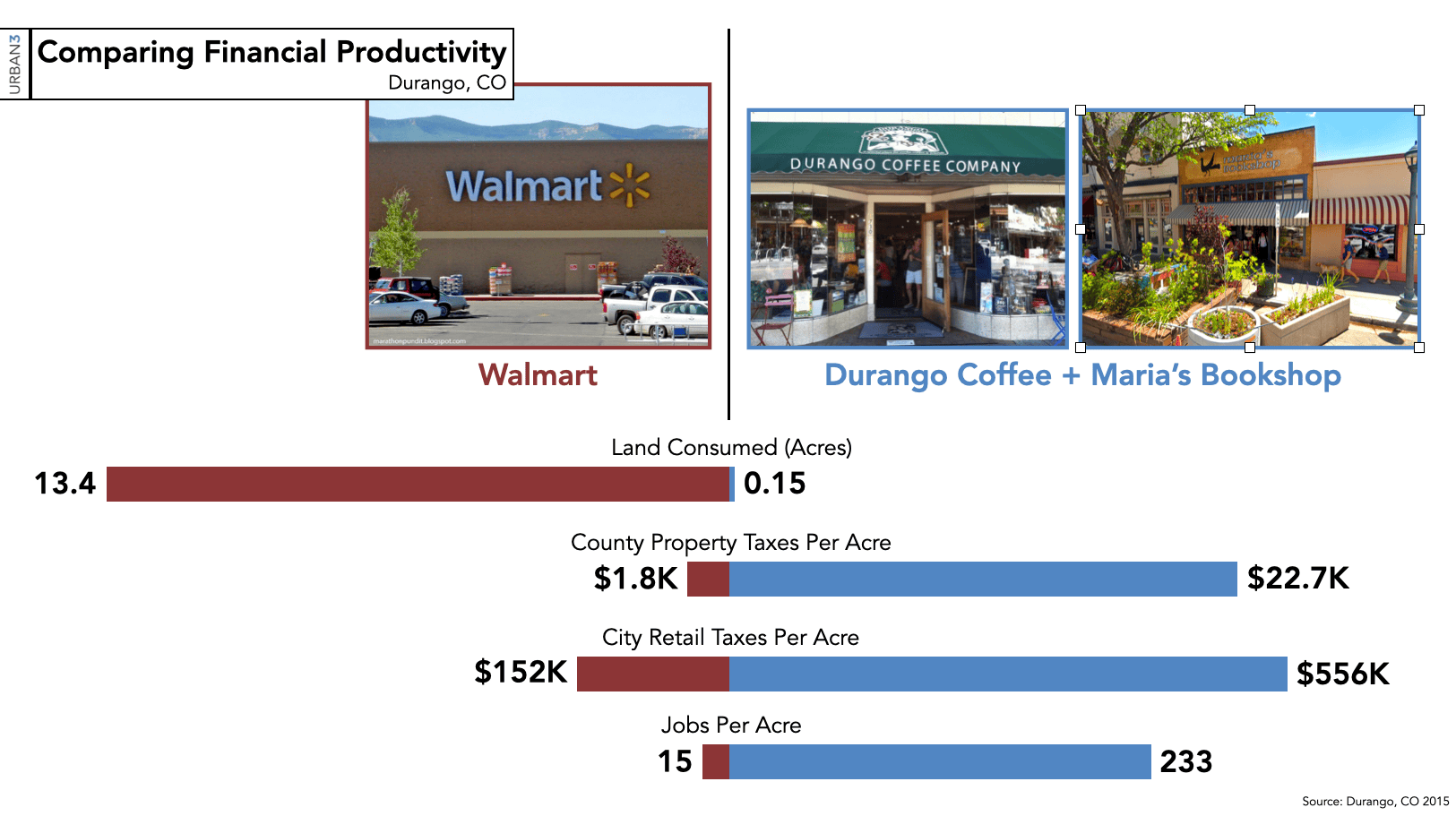
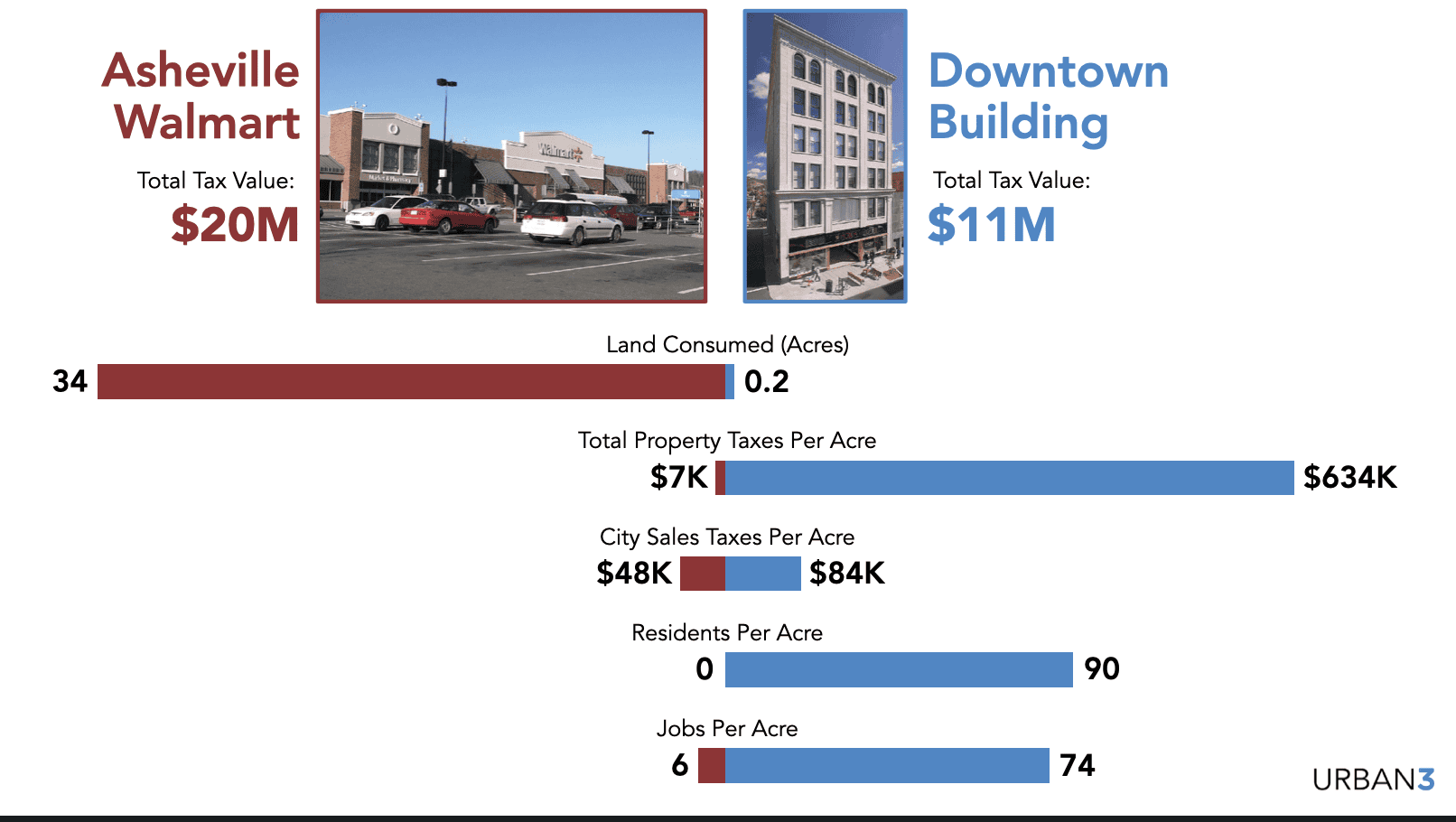
Many of Minicozzi’s recommendations reflect planning principles long embraced in European cities. Rather than promoting high-rise construction or dramatically changing the character of a small mountain town, he advocated making more efficient use of existing land through medium-scale, mixed-use buildings with storefronts on the ground floor and housing or offices above. “When you stack stories, you’re stacking dollar bills,” he said.
Recommendations for Franklin
Among his recommendations for Franklin, Minicozzi encouraged the community to continue investing in Main Street and the historic downtown. He also highlighted the largely underused upper floors of many downtown buildings, suggesting they could be converted into apartments, offices or space for new businesses without significantly altering the district’s historic character.
“Franklin has many challenges in creating more downtown revenue,” said Pink Peonies Boutique & Gifts owner Martha Holbrook. “Many building owners don’t have the funds to create second- or third-floor residential or office space for additional revenue. There would need to be serious investors.”
Holbrook also pointed to infrastructure and parking as issues that would need to be addressed alongside downtown development. “Short term planning and long range goals would have to be made,” she said, to make the kind of growth discussed during the presentation realistic.
Minicozzi said future growth should gradually extend outward from downtown so that the city’s gateways become natural extensions of Main Street rather than contrasting with it. Above all, he argued that long-term planning decisions should be guided by measurable data instead of assumptions or emotions. “I want you to ask harder questions and look at the data,” Minicozzi said. “If you can’t measure it, you can’t manage it.”
“He brings up a lot of points that a lot of people don’t think about as far as managing your growth and what your growth does to your community,” Macon County Manager Warren Cabe said. “It gave a lot of good points for us to look at and things to consider when we go through any of our ordinance processes or our discussions with the Economic Development Commission as far as growth.”
Residents raise questions
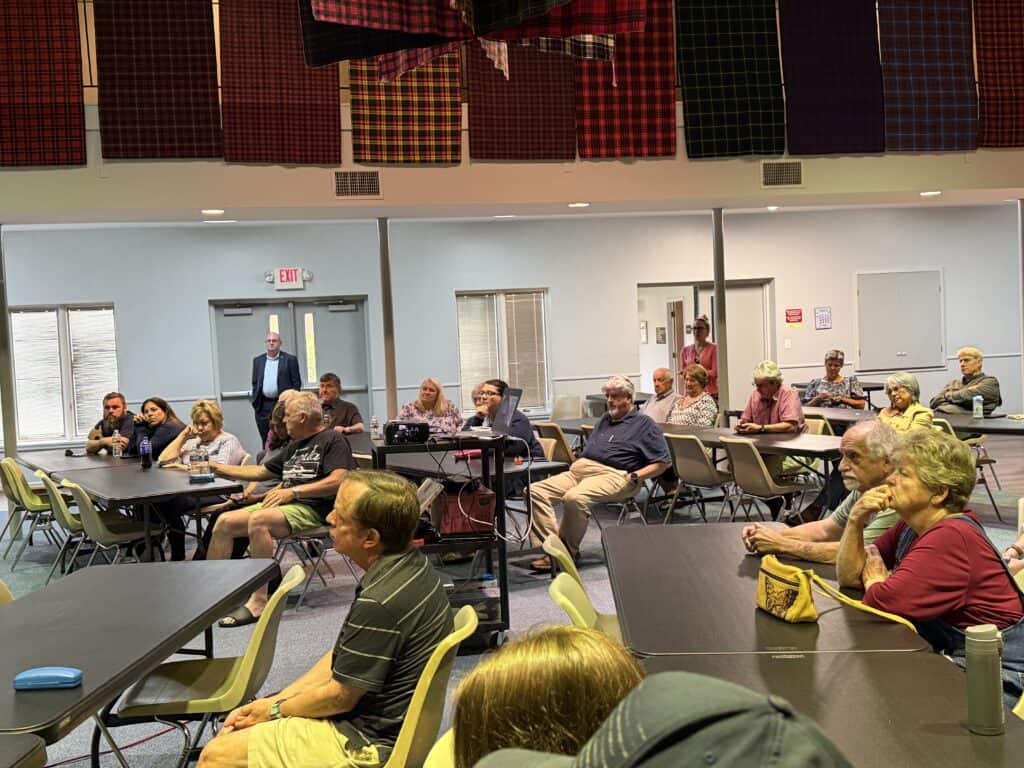
Following the presentation, residents had questions and concerns.
Holbrook expressed disappointment that more business and building owners were not at the presentation. They need a role as Franklin considers how to address the challenges facing downtown.
Among the topics that generated the most discussion were vacant and neglected buildings, future development along U.S. 441, parking, the potential use of upper floors in buildings and Franklin’s broader long-term development strategy.
In response, Minicozzi emphasized that no community can transform everything at once. He said meaningful change should begin with the historic downtown before expanding gradually into surrounding areas.
“Your downtown’s already doing all right. You’ve got some more room to go,” he said. “Support that change and reap the benefits.”
Cabe reflected on the presentation: “I think it opened my eyes to see how towns, in particular cities, contribute to the growth of the county overall,” he said. “I think it’s too early for me to say if we’re going to change, but I think it gives us some reason to think carefully through some decisions and tailor those to where the end goal needs to be.”