



As a part of its monthly meeting, county commissioners held a public hearing on the county’s planning board recommendations to further ensure restrictions against data centers developers that may target this area.
Public input focused on one theme: moratoriums
Data centers not welcome
The purpose of the hearing centered on updated definitions of server-based facilities within the ordinance itself, but potential data center construction and use generated the most public response at Tuesday night’s meeting.
The Macon County Planning Board, met Aug. 6 and proposed changes to Chapter 157 of the county Code of Ordinance. The first change, under “Applicability,” which includes 12 other high-impact uses, reads: Cryptocurrency Mining, Data Centers, and Server-Based Facilities.

Another update by the board included hours of operation parameters that reads:
“High impact uses shall conduct operations only between the hours of six o’clock a.m. and 10 o’clock p.m., except those operations that fall under the definition of Cryptocurrency Currency Mining, Data Center and Server-Based Facilities, which shall be confined to operating between the hours of eight o’clock a.m. and five o’clock p.m.”
Predictably, the public speaking signup sheet on data centers was full, with 14 eager to speak, each with a 3-minute limit. The overriding theme was a moratorium on data centers.
“Is having hours of operation a good deterrent for a county ordinance?” resident Lisa Walker said. She shared what she had researched: “Limiting data center operations to certain hours is legally vulnerable and the least defensible way to do it. Since data centers operate 24/7, nighttime shutdown requirements would essentially be a ban.”

She asked for a temporary moratorium like Franklin passed and Highlands is considering, as well as tighter language in the county’s ordinance.
Scaly Mountain’s Contance Neely acknowledged that ordinance amendments were appreciated but were not strict enough. She also asked for a moratorium and that the state law could protect a data center project without it.
Franklin resident Lorraine Ross offered, “I’m asking to recommend a moratorium. Also, establish a data center committee or task force. Across North Carolina, there are 30 towns or counties that have adopted moratoriums. Swain County has adopted a two-year moratorium and Clay County had done an outright ban on data centers.”
Following the recurring moratorium theme from speakers, Planning Board Chairman David Culpepper offered that the commissioners should take action with the current language changes now and pursue additional actions as well.
“If you want to build moratoriums or you want to change the ordinance completely, that’s up to you but changes should be made to patch up vulnerabilities in the current ordinance,” he said
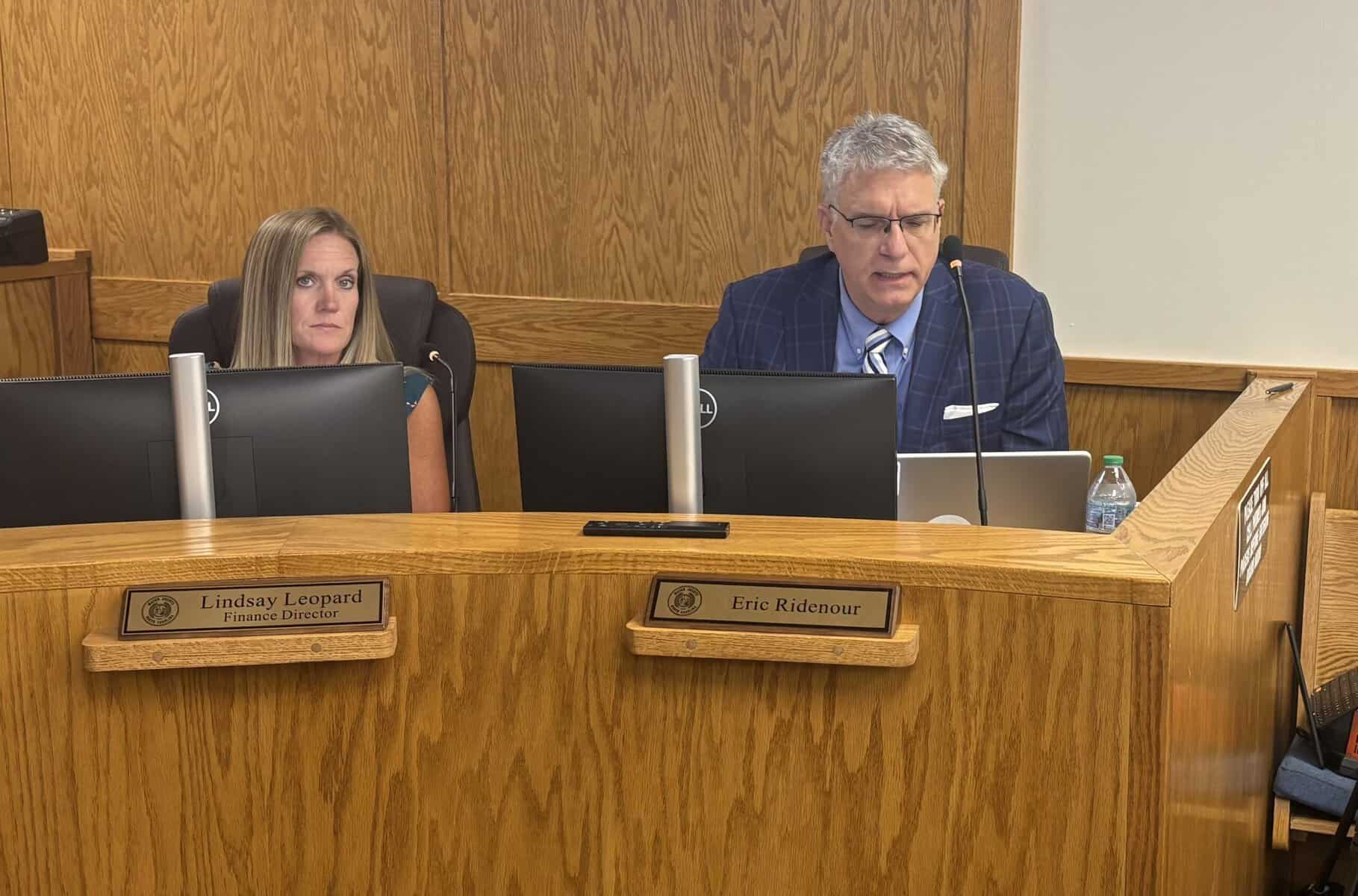
County Attorney Eric Ridenour (pictured above) summed up the situation from a legal standpoint. “It is better to regulate than to completely prohibit. Moratoriums are easily attacked. A county has to specifically find and identify the problem necessitating a moratorium.”
Ridenour referred to an unnamed county that proposed a moratorium and how they are still vulnerable. “They have to find alternatives considered, what approvals are halted, or how the moratorium will address the problem. If any of those are attacked, and successful, you have nothing. If you regulate to the point that it [data center construction and operation] isn’t going to happen, you’re in a better, stronger legal position than using a moratorium or just sitting back and studying it further.”
Responding to commissioner discussions following the public comment, Chairman Josh Young said, “I think this is one of the good times that everybody in this room agrees with the task at hand.”
Commissioners gave Ridenour a month to research the feasibility of implementing a moratorium for up to a year on top of implementing updated ordinance language submitted by the planning board.
Nonprofit Funding
County Manager Warren Cabe sparked a lively discussion when he asked for guidance regarding increased fund in responses from nonprofits. Contingency funds be used for such requests but he wanted a clearer process or policy.
Commissioner Gary Shields said a designated amount of funds once was set aside for nonprofit use when deemed appropriate by the county. However, currently, no such policy exists for expenditure of budgetary funds for nonprofits.
“These nonprofits are absolutely vital for the services they provide, but a county or a government body taxing its citizens to supply money to a nonprofit is not our role,” said Commissioner John Shearl, “A nonprofit organization that is critical to a community will be self-supported by donations. They should not be looking at county government handouts.”
In response to Shearl, Kellie Burns, a candidate for county commissioner and a sponsor of numerous fundraising events for nonprofits, offered a counter view related to grants and associated requirements. “What you don’t understand is when a nonprofit applies for a grant, they have to show community support. They have to show they are actually going out and trying to raise money.”
Burns used examples like No Wrong Door and Men’s Challenge of the Smokies to express how keeping people out of trouble actually saves the county money through less involvement from the sheriff’s department or emergency management services.
“I get what you are saying because I am all for responsible taxation and spending monies responsibly, but you have the importance of these organizations to consider,” she said.
Highlands Commissioner Amy Patterson then spoke on Mountain Findings, a nonprofit that collects unwanted furniture and other items. It then sells items within a facility to raise money for various organizations around Highlands. According to Patterson, around $200,000 was raised last year alone by that process.
In the end, commissioners agreed to let Cabe’s team work with the county attorney to determine legality criteria regarding county expenditures on behalf of any external, non-governmental organizations. Cabe advised he would come back to commissioners in September with guidance.
In other business
Cabe presented a design update on the Carson Convenience Center recycling project. Carson is one of nine staffed recycling locations around the county.
Financed through a $2.75 million grant, the project will upgrade the recycling and recovery buildings, and add a new baler. The project could be completed by Jan. 1, 2027.
In addition to the trash and recycling center upgrades, there is a consideration of adding recreational facilities on the premises which measures eight acres.
The board agreed on a plan to move forward with the convenience center project, as is, with an option for researching pricing of additional work on the recreational field.
Juvenile crime prevention annual plan
Lorraine Williams, a consultant to the division of Juvenile Justice and Delinquency Prevention, the 2026-2027 fiscal year certification and annual juvenile crime prevention plan, for which she requested approval.
From its executive summary, the Juvenile Crime Prevention Council “identified issues and factors which influence and impact vulnerable youth, at-risk youth, delinquent youth, and their families in Macon County.”
Williams presented various statistics across numerous “domains” such as family, alcohol/drugs, mental health, school, community and peers, and aggression. In all, 53 youth were assessed on the domains with varying results realized by counselors.
Across five areas of the program, the plan projected an expenditure for FY 26-27 to be $159,109, with Macon County providing $33,256 of that total.
Following a motion by Commissioner Barry Breeden, and seconded by Danny Antoine, funding was approved unanimously by the board.