


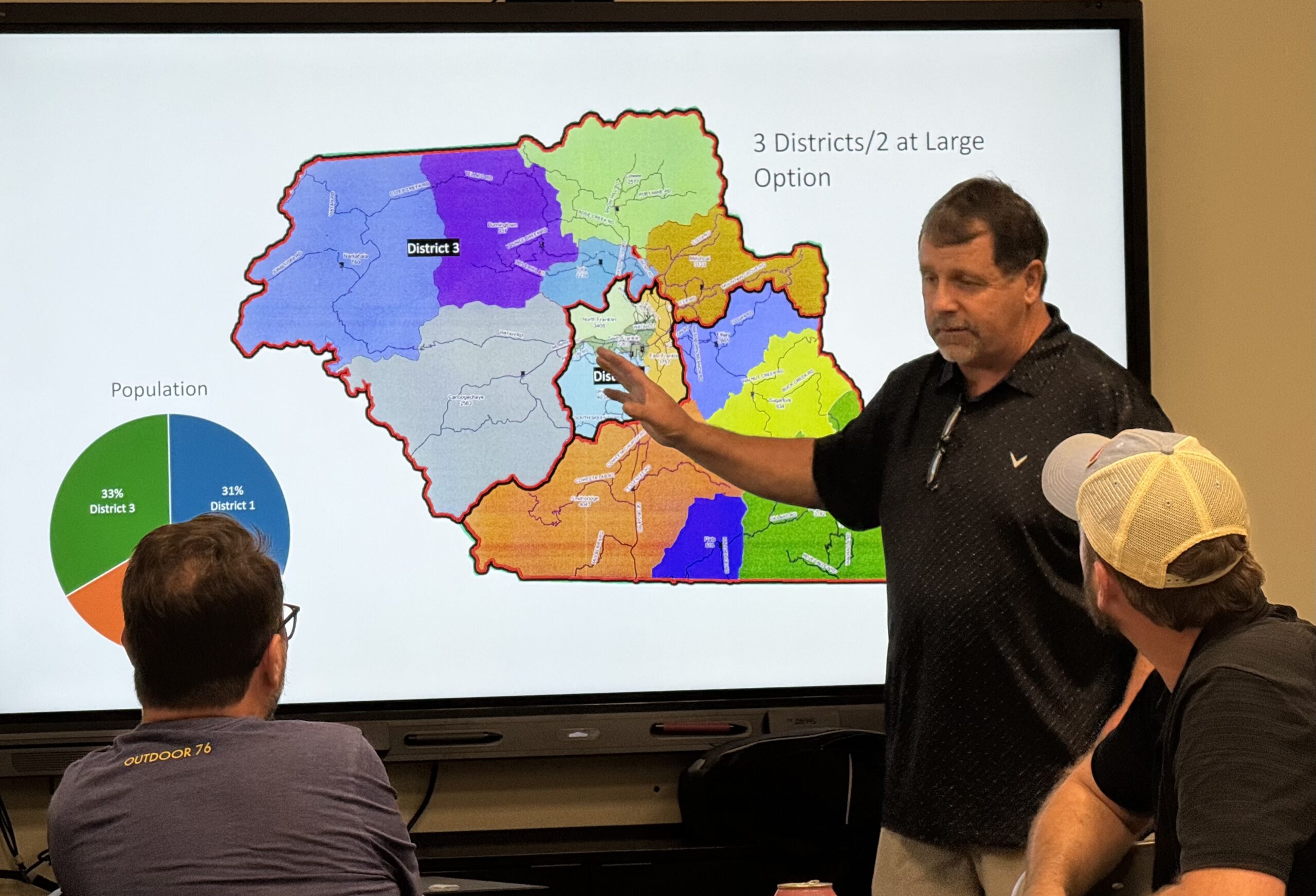

While data centers are the hottest topic facing many local governing bodies, the county planning board took time to choose its preferred plan for an issue that’s been simmering for months: redistricting.
Since spring, the board has reviewed and debated several plans for redrawing county commissioner representation, even tentatively approving a fully at-large proposal.
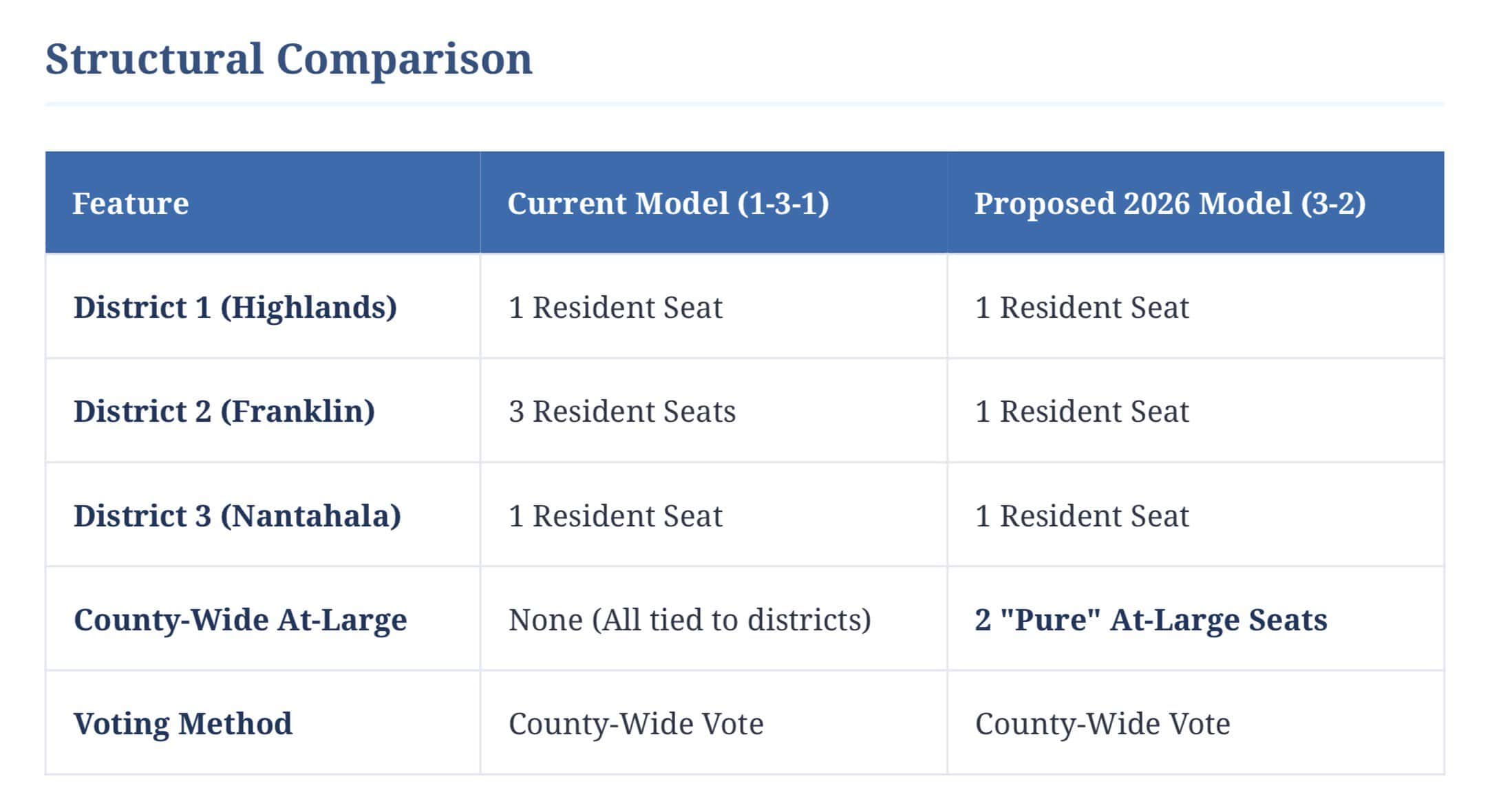
The plan now favored by the board is a 3-2 system with three districts based on residency, and two countywide at-large seats. The decision is now up to the county commissioners to decide and send to the state General Assembly.
Why the planning board
In February, the issue was raised at Macon County Board of Commissioners. Then in March, chairman Josh Young tasked the planning board with taking up the debate to hear out the community and guide commissioners on how to address issues of fairness.

Macon County currently uses a mixed “District-at-Large System” or “1-3-1.” The Board of Elections says that while candidates must reside in a specific district to run for and hold office there, commissioners are elected by all voters in the county through at-large voting. Every registered voter in Macon County, regardless of where they live, participates in all five seats on the board.
Commissioners now serve 4-year staggered terms. In presidential election years, the seat for District 3 and one of the seats for District 2 are contested. In mid-term, off-years like 2026, the other seats are contested.
District 1 commissioner John Shearl and District 3 commissioner Barry Breeden raised concerns that candidates from their districts are not able to run in each election cycle, while candidates from District 2 get more frequent opportunities. To Shearl, this means voters in Districts 1 and 3 are disenfranchised because they cannot vote for the same candidate from each district every two years, while candidates from District 2 can dominate the board by virtue of their residency status.
The planning board discussed the options over the past few months on the merits of at-large, direct, and mixed systems of representation. They heard differing viewpoints of local citizens at each meeting and how to ensure the county’s change would be consistent with the North Carolina state constitution under Chapter 153A.

Voting system, districts, constitutionality
By the end of May, the board decided to break down the question of “fairness” into parts. At the June 4 meeting, the board unanimously agreed to recommend that the county move to make all five seats “at-large.”
At July’s meeting, the board moved to the question of having a three-two, four-one, or five residency and at-large district plan.
The Town of Highlands representative Amy Patterson said, “The options are unlimited on how you draw this map.” But, the board had to narrow down the choices for the county to move a plan forward and chose to use the 2020 census and census blocks as the basis for population size.
In public comments, the majority of those speaking at the July 2 meeting requested the planning board reconsider the fully at-large system.
Six of the eight speakers requested the county go to a “pure representation” or “direct vote” plan in which commissioners would be elected by constituents residing only in their home district. Opinions remained varied if the county should be divided into three, four, or five districts, or simply to leave the current system intact.
Margaret Pickett summed up the prevailing public opinion that evening, “District voting, also known as the pure voting option, allows the people to choose their representative, gives greater access to their representative, and allows the representative to maintain better knowledge of the district’s needs and issues. It also makes the representatives more accountable to the voters.”
“Ultimately, it’s not this board’s decision”
Despite these appeals during meetings, the board decided it would go with the 3-2 plan, observed by both sitting members of the Board of Commissioners and candidates for the office who sat in these sessions to gauge public sentiment.
Member Marty Kimsey said the round of discussions had changed his viewpoint on the best system to move to, and he felt now comfortable with the proposed 3-2 plan.
Chairman David Culpepper was the lone dissenting vote.
“I’m not comfortable adding my name to something I don’t know the final details of. I don’t see the map that covers the representation of people in District 1 and District 3. I’m not certain that I want to have a nucleus of concentrated population having too much control over parts Macon County. I’m not a 3-2 guy. I like 4-1 best,’ he said. “I like the idea of people being able to run every two years. Give the people the most power over their government. We should want to limit their power over our own individual lives.”
The recommendation now moves to the Macon County Board of Commissioners who will address it in either the August 11 or September 8 regular meetings.