

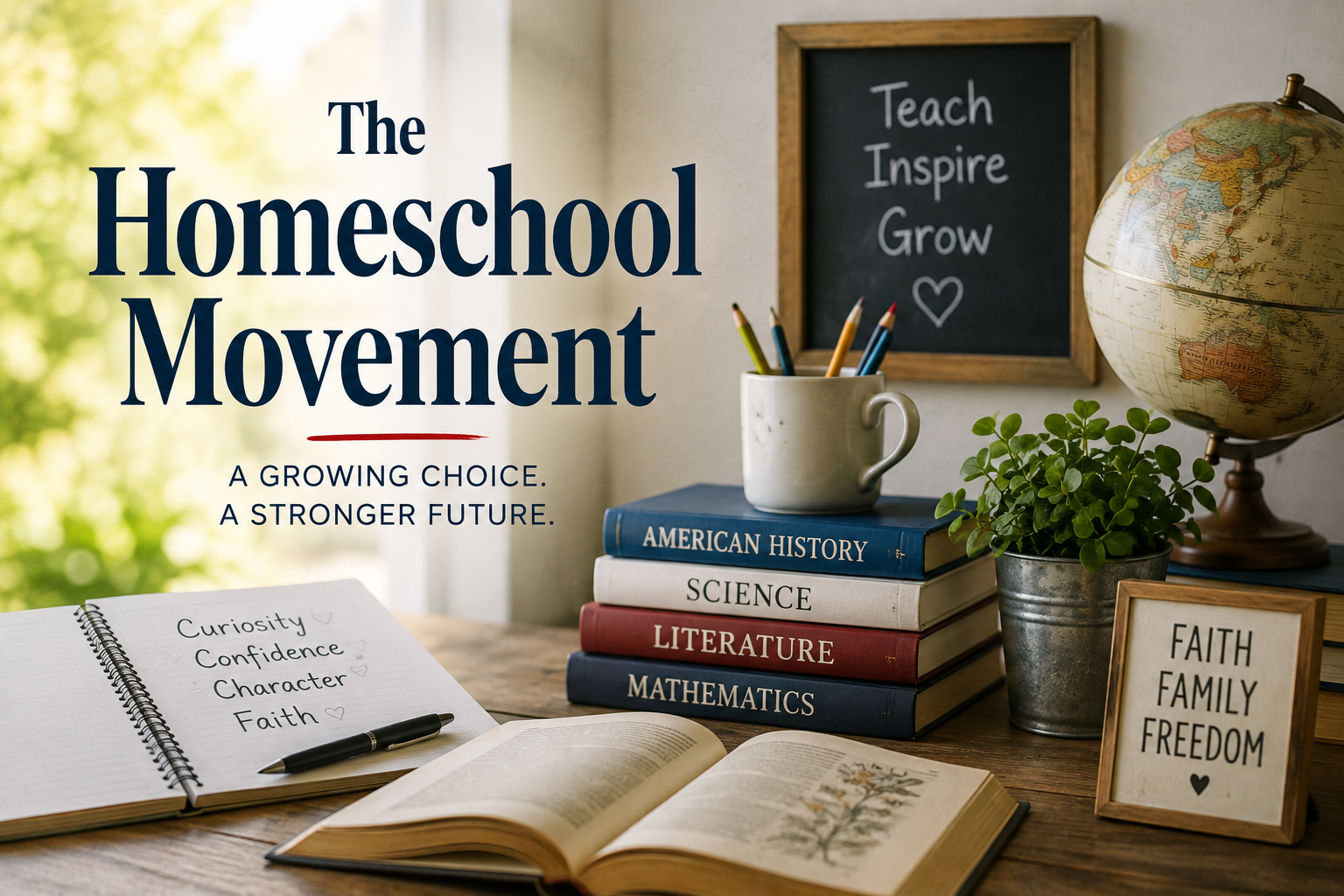

Across the country and right here in Macon County, more parents are making a big change in their children’s education. What used to be a rare choice has quickly become one of the fastest-growing education trends in North Carolina. In fact, the most recent report from the North Carolina Division of Non-Public Education (DNPE) shows 588 declared Home Schools in Macon County serving 937 students. Families from all backgrounds are moving away from traditional public schools and taking direct control of their kids’ learning and personal growth.
While every family has its own reasons, one main concern comes up most often: protecting family values. For millions of parents, homeschooling is a way to protect their children from a school system that they feel is replacing traditional lessons with political opinions and social theories.
Protecting Moral Foundations and American Values
In recent years, local school boards and public school classrooms have turned into places for political debates. Many parents are worried because regular school subjects like reading, history, and social studies are changing to match viewpoints that go against their family’s personal beliefs. Topics about right and wrong, culture, and human nature—which used to be taught mainly at home—are now often taught in public classrooms without parent insight.
Homeschooling gives parents a direct choice. By teaching at home, parents can make sure their children are not exposed to political bias or values that clash with their faith and heritage. Instead of learning a newly revised, one-sided view of history, homeschooled students can study classic literature, government and constitutional basics, and principles like hard work and personal responsibility. It lets families teach good values naturally throughout the school day, making sure that learning and strong morals go together.

Better Learning and Customizable Lessons
Along with protecting family values, homeschooling offers clear academic benefits. Standard public school classrooms usually teach to the middle, which can leave advanced students bored and struggling or non-English speaking students behind. Crowded classrooms, too much testing, and classroom behavior issues can make learning harder.
In contrast, homeschooling allows for personalized teaching. Parents can adjust lessons to match how their child learns best, moving faster in subjects the child finds easy and spending extra time on harder topics. Research shows that homeschooled students often score higher on standardized tests and college entry exams than public school students, even if their parents are not trained teachers. Main subjects can often be completed in just a few focused hours, leaving plenty of time for sports, volunteering, and spending time with family.
Navigating the Practical and Legal Framework
For local families interested in homeschooling, starting out in North Carolina is straightforward. The state manages homeschooling through the Division of Non-Public Education (DNPE), setting basic rules while giving parents control over their kids’ education.
To legally start a homeschool in North Carolina, parents must complete a few simple steps:

- Parent Qualifications: The main parent teaching the child must have at least a high school diploma or a GED.
- Filing a Notice: Families must file an online “Notice of Intent to Operate a Home School” with the state for children between the ages of 7 and 16.
- School Name & Schedule: Families pick an official name for their homeschool and teach for at least nine months out of the year.
- Basic Record-Keeping: Parents must keep basic records of attendance and up-to-date vaccine lists at home.
- Annual Testing: Students must take a standard national achievement test once every school year (like the CAT, Iowa, or Stanford tests). Parents keep the test results in their own files rather than sending them to the state.
North Carolina law does not force parents to use specific textbooks or state programs. Parents have complete freedom to choose the books, reading materials, and teaching styles that work best for their children and match their family’s values.
Impact and Future Outlook: The Public School Response
This shift moves public schools from a local monopoly to a competitive marketplace:
- Financial and Operational Impact: Public school funding is tied directly to enrollment numbers. When families leave, districts lose per-pupil funding.
- Cultural Shift: The movement signals growing parental insistence on agency—families expect education to align with their specific values, pace, and safety standards rather than accepting a one-size-fits-all model.
- Redefining “Public” Education: Districts must view parents as active clients who have viable alternatives rather than a captive audience.
Rather than expecting a total return to traditional 8-to-3 schedules, our schools can build bridges to re-engage families:
- Part-Time Enrollment: Allow homeschooled students to enroll in specific high-value public school offerings, such as advanced STEM labs, band, CTE programs, or athletics.
- Transparent, Neutral Curricula: Address parental concerns directly by offering clear visibility into instructional materials, focusing on core academic mastery, and respecting the primary role of parents in moral development.
- Flexible Learning Models: Expand district-run virtual academies, self-paced modules, or schedules that provide structure without sacrificing family flexibility.
- Access to Support Services: Offer a la carte access to standardized testing, special education evaluations, or college counseling.
- Focus on Safety and Climate: Address non-academic reasons families leave—such as bullying or classroom distractions—by enforcing clear behavioral standards.
A Bright Future for Family-Based Education
Education shapes how children see the world, their country, and the people around them. For a growing number of Macon County families, homeschooling is a low cost way to focus on high-quality learning and strong parental guidance. By taking charge of their children’s education, parents can offer personalized lessons while keeping their core values at the center of their kids’ lives. At the same time, this movement should encourage our school leaders to adapt, innovate, and better serve every student in Macon County.