


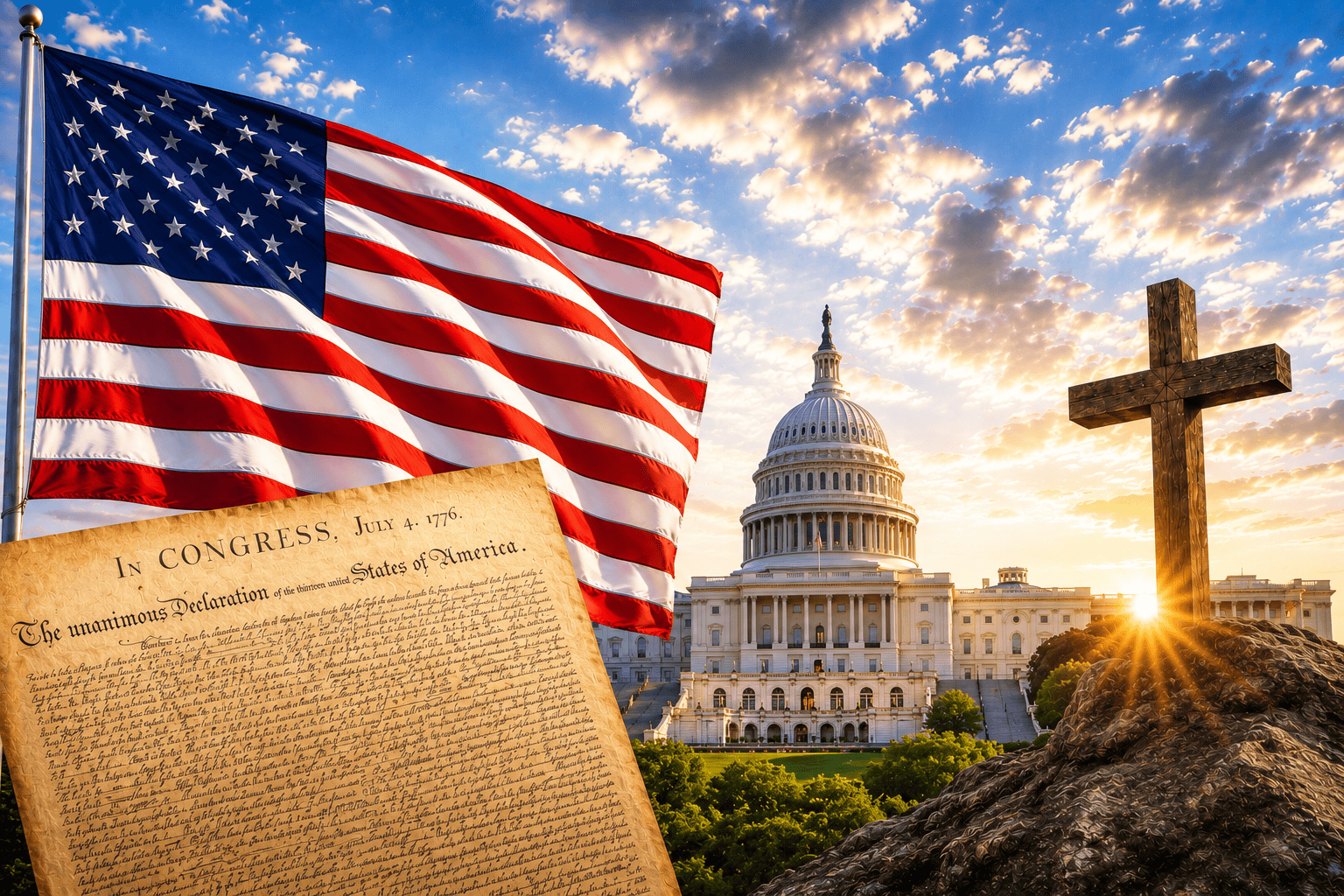

July 4th, 1776 is a date that should be known and appreciated by every single American. It was nearly 250 years ago that our founders sent the Declaration of Independence to the Monarchy of the British Empire.
The founders of our nation declared that we are an independent and sovereign union. They definitively and unanimously declared the thirteen United States of America a separate and free people.
I think it is fitting to consider our nation’s independence and the basis for that independence as we approach the monumental 250th birthday of our republic.
When reading the Declaration of Independence, you will find four references to God: paragraph one “Nature’s God,” paragraph two “their Creator,” and the final paragraph “the Supreme Judge of the world” and “divine Providence.” The references to God make the separation of Britain and the colonies a principle rather than an opinion.

A principle is rooted in objective or transcendent fact or truth, while an opinion is rooted in the variableness of human thought. It was not just the opinion of the colonists that they should be free and independent; it was rooted in their knowledge of the one true God. Their value as human beings and right to a life of liberty is inextricably Christian.
The Bible says that human beings are “created in the Image of God” (Genesis 1:27-28). The Scriptures teach of only one creation that is in the “Image of God,” humanity. As special creations, human beings are valued by their Creator distinctly and inherently.
Psalms 119:89-90 says, “LORD, your word is forever; it is firmly fixed in heaven. Your faithfulness is for all generations; you established the earth and it stands firm.” The one who “established the earth” gets to determine truth. If His Word is forever, then we can trust what He says about humanity and our intrinsic value.
Our founders understood that their Declaration of Independence was established in something greater than themselves. The United States of America was undeniably established upon a Christian foundation.

Patriotism through a Faith lense
Running through the tributaries of our culture and society is a biblical DNA. I believe our biblical DNA is the reason our republic has been and still is so consequential.
On the one hand, our biblical foundation is a positive; on the other hand, it is an obstacle. You may ask, “An obstacle to what?” It is an obstacle to clearly understanding the Gospel and what it really means to be a Christian. For example, in Somalia, China, or North Korea, Christians are distinct from everything around them. They walk into the constant head winds of their surrounding cultures, social norms, and majority religions.
In America, our foundations are Christian oriented which can cause a conflation between social Christianity and authentic Christianity. Our money says “In God We Trust,” our pledge says “under God,” and our politicians say “God bless.” Since the distinction between the Christian faith and social norms is not as pronounced as it is in other countries, we run the risk of getting the two confused.
As a Christian, I am really a citizen of two countries. I am a citizen of the United States of America by physical birth and a citizen of Heaven by spiritual birth. My citizenships usually run parallel to one another without any conflict. However, there are times when I have to consciously show loyalty to one or the other.
As a Christian, I am a citizen of Heaven first. The Heavenly Kingdom where Christ is King is my first priority. I am loyal to America as long as it does not undermine my devotion to Christ.
When America has a majority of its citizens who are patriotic, it is no doubt better off. Patriots desire what is best for their country and consider its well-being paramount. The problem arises when lines begin to blur and patriotism becomes one’s faith.
Patriotism becomes a faith when its nation, flag, troops, contributors, and ideals are venerated. For example, do we honor the flag more than we honor Christ and His Word? Do we believe that everything our nation does is justified before God? Do we causally associate with God in order to reap the perceived benefits of Christianity? All of these questions have to bring us back to the question of loyalty.
If it became necessary, would you choose Christ or America?
My fear is that many Americans view their citizenship here synonymous with their Christianity. In other words, they think their patriotism to America equates to a faith in or adherence to Christianity. If we are going to rightly understand the Biblical faith of Christianity, we have to understand that it is ultimately independent of our patriotism to our country.
To be clear, I am a patriot who loves the United States. I love our troops, our veterans, our flag, our constitution, etc. I am simply making a point and issuing the warning to not mistaken patriotism for faith.
There are great patriots who are not Christians. There are those who have served our country who do not know Christ. America will not endure forever, but God and His Kingdom will. Our goal should be to lead all people into an encounter with the Gospel. We should honor our nation and those who serve it, while also teaching that God’s Kingdom and His Word always come first.
As we anticipate with excitement the unprecedented celebrations to come with our nation’s 250th birthday, let us consider whether or not we have truly trusted in the death, burial, and resurrection of Jesus for our salvation. Let us make sure we have not equated our patriotism with our faith—the two are friends but are ultimately not the same.