
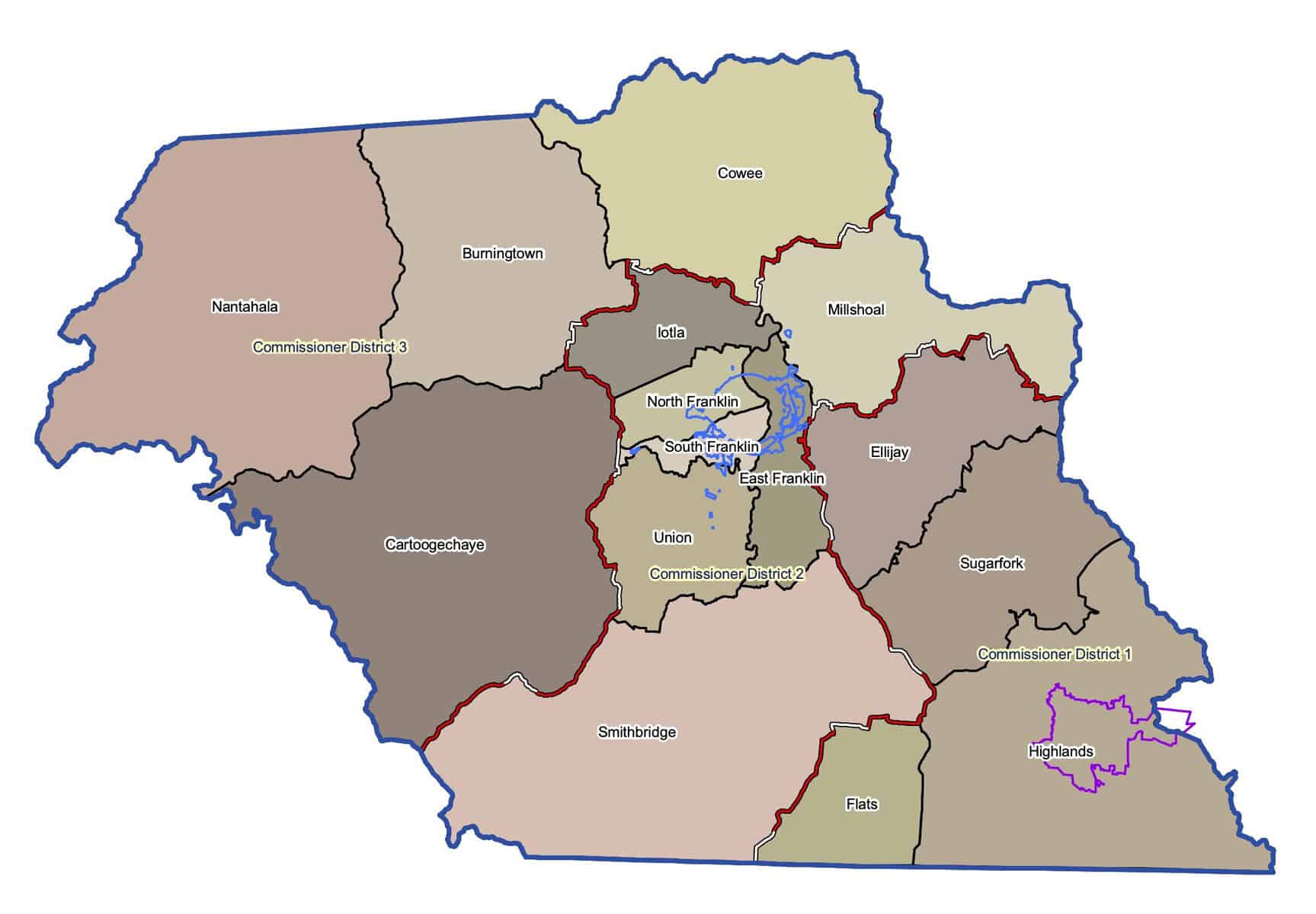

At its most recent meeting, the Macon County Planning Board began its role in the process of electoral redistricting for the Board of Commissioners.
County Commissioner John Shearl addressed the board and laid out why he initiated the proposal at the December county commissioner’s meeting.
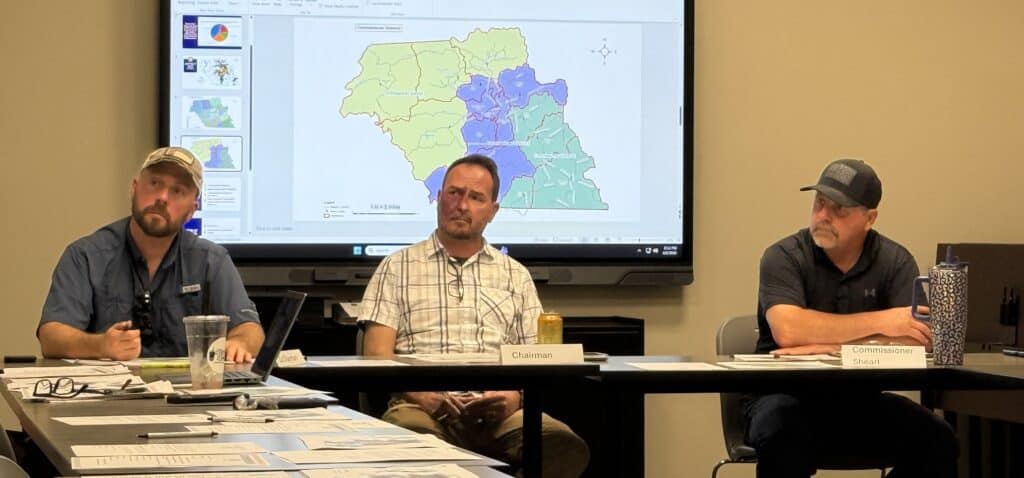
According to Shearl, commissioner Barry Breeden called him prior to that meeting and asked him to place redistricting on the agenda. He said Breeden “agrees 100 percent that his constituency in District 3, as well as mine in District 1, are disenfranchised. We are not offered the same – the citizens, the candidates, taxpayers – everybody is not offered the same opportunity as everyone in District 2.”
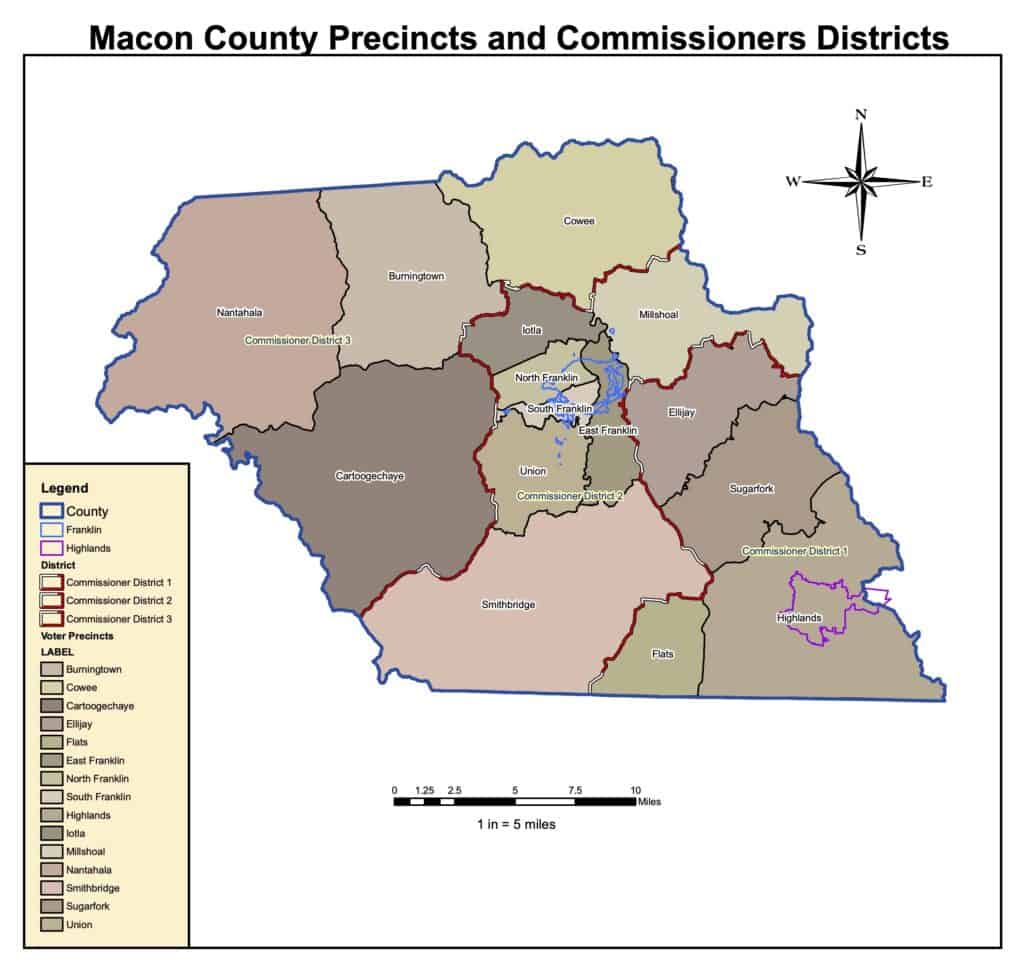
Presently, the Board of Commissioners is made up of five elected representatives drawn from three districts. Each district is roughly the same population size.

- District 1 consists of the precincts of Ellijay, Flats, and Highlands.
- District 2 consists of the precincts Iotla, Millshoal, North Franklin, East Franklin, South Franklin, Union, and Smithbridge.
- District 3 consists of the precincts Burningtown, Cartoogechaye, Cowee and Nantahala.
The rub comes in with how often candidates have an opportunity to run for office (every four years), whether the population figures have kept up with the original districting, and whether or not key taxpayer bases are receiving adequate representation within the county.
“We’re not in a hurry. We gotta get it right,” Chairman Culpepper.
Shearl said that according to the UNC School of Government, out of 100 counties, 61 are governed by five commissioners. Macon is the only five-member county board with single member districts mixed with multi-member districts.
He is concerned the system devised for Macon County might be unconstitutional under North Carolina law. While the present structure for local elections has not been tested in court, Shearl said a change would ensure greater fairness in representation, prevent disenfranchisement, and avoid a potential legal challenge.
A quirky system
Local resident Jim Gaston noted the quirk of Macon County’s system, “Under the current districting and voting rules, the entire county votes for each commissioner candidate, whether a voter lives in the district of a candidate or not. Candidates are limited due to their physical address, but voters from outside those districts can decide a district candidate winner. Gaston supports reforms based on consistency and fairness. He noted that in March voters outside of District 1 (Highlands) determined the winner of that race.
The Board of Commissioners first attempted to make a change in 2023, but the proposed structure and companion bills by State Senator Kevin Corbin and State Representative Karl Gillespie were not voted on before the NC General Assembly session ended in 2024.
After the December commissioner meeting, feedback from attorneys spurred Chairman Josh Young to direct the planning board to take up the issue, as its structure and rules allow for lengthier debate and interaction for public comments.
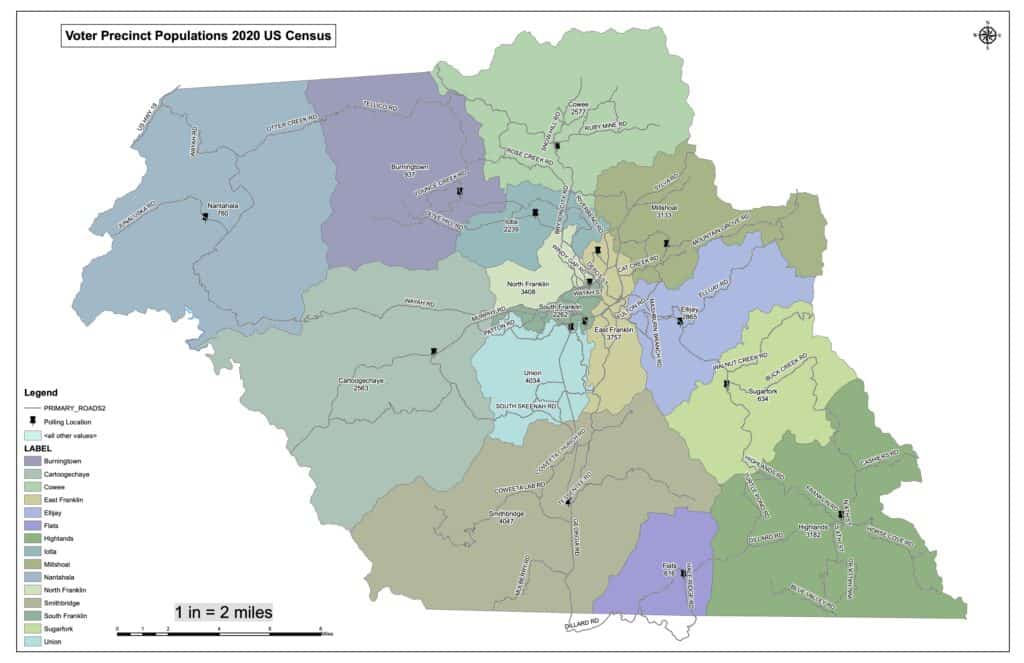
Shearl wants to dispel the idea that redistricting would be based on partisan lines and on registered voter numbers. “It’s not based on voters. It’s based on every man, woman, and child in this county. Because whether they vote or not, they still have to be represented.” Board members determined the national census would be the controlling source for any future efforts.
According to the 2020 Census, the county population was 37,014, but a recent census estimate in July 2025 reported that the county grew to 39,232 residents.
He also pointed out that neighboring counties have devised other approaches including Jackson County, which has four distinct districts and one countywide at-large seat.
Options for consideration could be that the entire county votes on each person from each district, or just the district voting on their representative that comes from that district. “There’s a lot of different ways to slice it,” he said.
Take your time, do it right
Because the General Assembly has a shorter session in 2026, a new redistricting formulation would not be acted upon until 2027.
During the discussion, board members clarified some procedural details:
- New districts need to contain similar population sizes.
- Redistricting would not require a separate review by the Department of Justice. In the past, some counties in North Carolina have been subject to special provisions of the Voting Rights Act of 1965. Macon County has never been one of those jurisdictions.
- Board member Marty Kimsey said the Planning Board should leave all options open and invite full feedback from the community at a May 7 public meeting.
- The County Attorney will attend the public meeting to ensure the process meets required guidelines, and to answer legal questions.
As the meeting closed, a member of the public who had spoken in favor of redistricting wryly observed, “It gets messy, don’t it?” Chairman David Culpepper nodded in return, but pledged, “We’re not in a hurry. We gotta get it right.”
The group agreed to hold the May 7 public hearing at 5 p.m. in the A/B room of the Macon County Human Services Building. Click here to see the PowerPoint presentation.
Smaller board, new leadership
The Board unanimously elected local business owner and former Town of Franklin (TOF) Councilman David Culpepper as its new chair, taking over from Jean Owen whose term expired. The Board elected Luke Jakushev as its new vice chair.
The Macon County Board of Commissioners recently reduced the size of the board from 11 to 5 in an effort to improve the Planning Board’s productivity. The Planning Board struggled with attendance to meet quorum requirements during 2024-2025 while tackling some contentious issues including revisions to water quality and flood-related ordinances. This meeting was the first in over a year.
Impervious surface variance
The Board also approved a variance request from Franklin regarding the upgrade to its water treatment facility.
Franklin City Manager Amie Owens requested a 70 percent increase in the water shed acreage area as an effort to stay ahead of future project phases over the next few years. It may not be used, but the Town wanted the latitude to make changes if necessary.
“The current well is 56,000 gallons. The one that we’re going to put in is 250,000 gallons,” said Owens. “And then as we continue to grow, there is the potential for yet another tank. And what that does is actually give us storage capacity of treated water so that we’re not having to run the plant… [m]ore often. We’re more efficient that way,” explained Owens.
Owens said that in the event of an emergency, at least one million gallons of potable water will be available for citizens, even if there’s an issue with the system as a whole. “But we also want to protect the watershed because that is actually the water source for the town of Franklin.”
The Planning Board agreed with Owens’ assessment, noting that both town and county residents receive water from the plant. This issue also will be open to public comments at the May 7 meeting.